
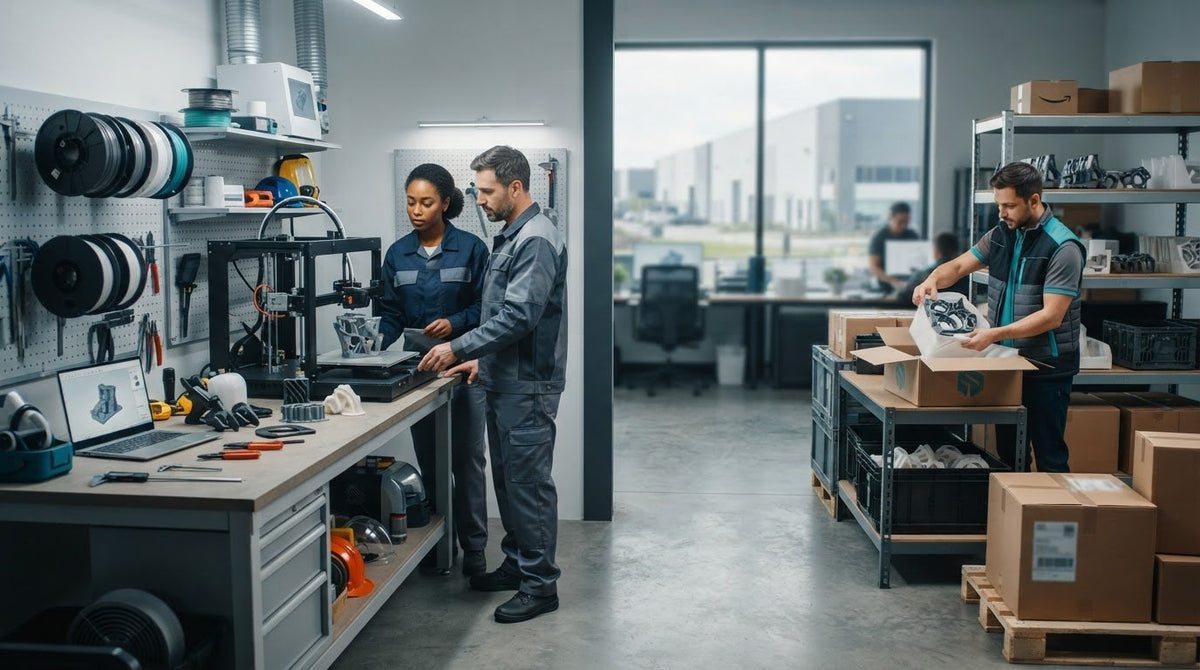
Buying a 3D printer can cost more than outsourcing, even when each in-house part appears cheaper. Supplier quotes can be difficult to compare when they include different materials, finishing, delivery, or service levels. A useful in-house 3d printing vs outsourcing cost analysis UAE businesses can use looks beyond the price per part to the full expense and effort behind every accepted print, with expert insights from Additronix.
If you’re weighing ownership against outsourcing, the right answer depends on how often you print, what your parts require, and how much capacity you can use consistently. This guide will help you estimate total cost of ownership, identify a realistic break-even point, and match your production needs to the right approach. We’ll compare equipment, materials, setup and training, maintenance, staff time, electricity, storage, delivery, and applicable tax considerations. You’ll also see what an in-house setup needs to run reliably, so you can decide whether to keep production external, bring it inside, or take a measured first step.
Key Takeaways
- Compare full printer ownership costs with outsourcing charges, not just the machine price against a supplier quote.
- Calculate the cost per usable part by including annual equipment costs, materials, labour, maintenance, failed prints, and accepted output.
- Match your production pattern to the right model: occasional prototypes, repeat parts, and frequently changing designs each bring different cost and workflow trade-offs.
- Assess part size, material, tolerances, finish, workspace, storage, ventilation, operator skills, and post-processing time before committing to in-house production.
- Explore how suitable equipment, materials, installation, and training can help build an in-house workflow around your parts and expected printer use.
US 3D Printing: In-House vs Outsourcing Costs
In-house 3D printing means buying and operating equipment within your business. Outsourcing means paying a supplier to produce parts as needed. Neither model is automatically cheaper: ownership brings upfront investment and ongoing operating costs, while outsourcing usually converts production into recurring charges for each order.
For a fair UAE cost comparison, match like with like. A supplier quote may cover production and finishing, while an in-house estimate needs to include the resources required to deliver an accepted part. Your operating setup matters too. Electricity tariffs depend on the applicable emirate and customer category, while delivery, material storage conditions, and order frequency can all affect the calculation. If you’re new to the broader field, this overview of additive manufacturing introduces its terminology, processes, and applications.
What does in-house 3D printing cost beyond the machine?
Total cost of ownership is the combined cost of equipment, operating expenses, labour, and failures over the period you use the printer. Separate one-time or occasional purchases from costs that recur as you produce parts:
- Setup and ownership: printer, installation, software, workspace preparation, and operator training.
- Operating expenses: filament or resin, electricity, maintenance, replacement parts, and post-processing supplies.
- Production effort: staff time for preparing jobs, monitoring prints, removing supports, finishing parts, and managing materials.
- Unusable output: failed prints consume material and machine time without creating an accepted part.
Some items are direct cash expenses, such as materials or spare parts. Others use internal resources, including staff hours, workspace, and troubleshooting time. Track both. A printer may have modest running costs but still absorb valuable employee time or remain underused.
What is included in outsourced part costs?
Outsourcing charges may cover part production, with finishing, packaging, and delivery priced separately or included in a quote. Repeat orders can also require internal time to prepare files, communicate specifications, review results, and process purchasing administration. Track these internal hours separately from supplier charges so the comparison reflects the full workflow.
Quotes can vary with material, part geometry, quality requirements, finishing needs, and order size. A simple prototype and a detailed part with specific surface requirements aren’t necessarily comparable, even if their dimensions are similar. For a fair comparison, define the same accepted output, finishing level, delivery destination, and quantity in both cost models.
How to Calculate In-House 3D Printing Costs in the UAE
A reliable cost model starts with your own production records and operating conditions. For an in-house 3d printing vs outsourcing cost analysis UAE businesses can act on, use the electricity tariff that applies to your site, along with realistic printer operating hours and utilization. Generic energy estimates or an optimistic print success rate can make ownership look cheaper than it is.
Build a realistic total-cost-of-ownership model
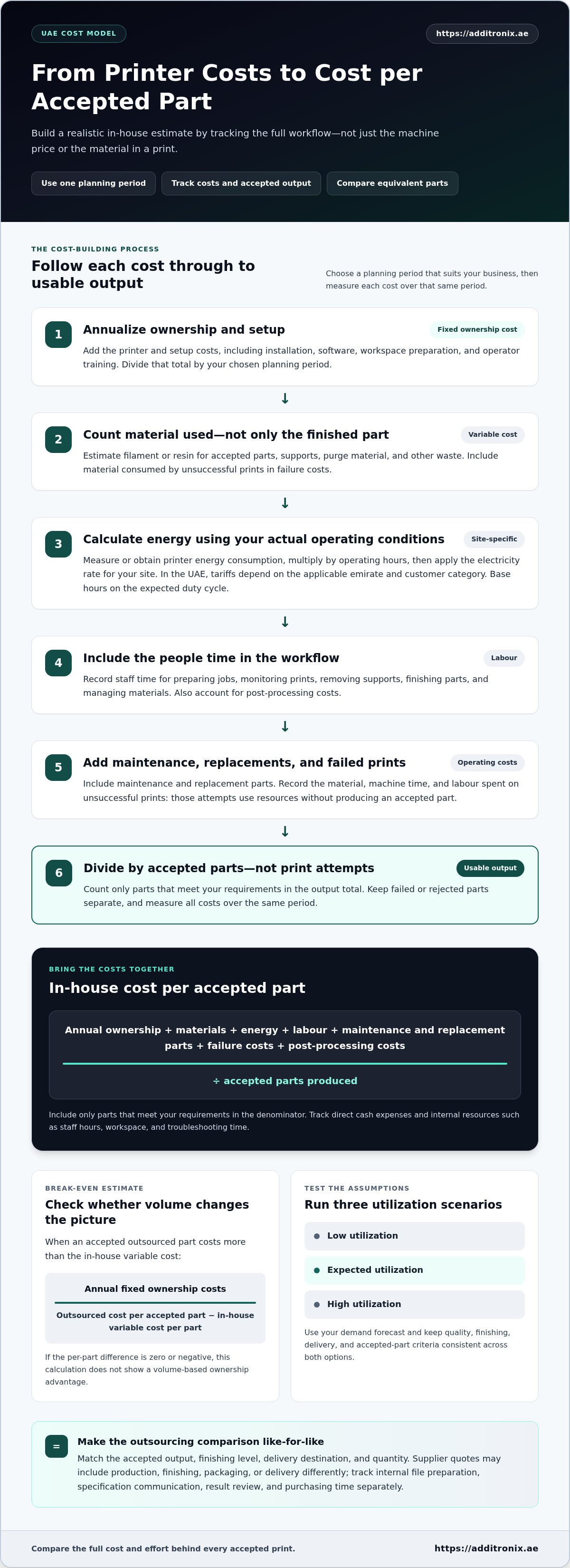
Choose a planning period that suits your business, such as the period over which you expect to use the equipment. Annualize the printer and setup investment across that period, then add annual operating costs. Work through these steps:
- Annual ownership: Add the printer and setup costs, then divide by your chosen planning period.
- Materials: Estimate filament or resin used for accepted parts, supports, purge material, and other waste.
- Energy: Measure or obtain the printer’s energy consumption, multiply by operating hours, then apply your actual electricity rate. Base operating hours on the equipment’s expected duty cycle.
- Labour: Include staff time for preparing jobs, monitoring prints, removing supports, finishing parts, and handling materials.
- Maintenance and failures: Add maintenance, replacement parts, and material and labour consumed by unsuccessful prints.
- Usable output: Count accepted parts, not print attempts. Record failed or rejected parts separately.
In-house cost per accepted part = (annual ownership + materials + energy + labour + maintenance and replacement parts + failure costs + post-processing costs) ÷ accepted parts produced. Measure each cost over the same period, and include only parts that meet your requirements in the denominator.
Calculate break-even volume without assuming a universal threshold
Compare annual fixed ownership costs with the per-part difference between outsourcing and in-house production. If an accepted outsourced part costs more than your in-house variable cost, divide annual fixed ownership costs by that per-part difference to estimate the break-even quantity. If the difference is zero or negative, this calculation won’t show a volume-based ownership advantage.
Run low, expected, and high utilization scenarios using your demand forecast. Keep quality, finishing, delivery, and accepted-part criteria consistent across both options. Use this fill-in worksheet:
- Annual fixed ownership costs: AED [_____]
- Outsourced cost per accepted part: AED [_____]
- In-house variable cost per accepted part: AED [_____]
- Expected annual accepted parts: [_____]
- Estimated break-even quantity: fixed ownership costs ÷ (outsourced unit cost − in-house variable unit cost) = [_____]
Refine the estimate as production data accumulates, using measured material consumption and actual staff time. To explore equipment, materials, installation, and training for an in-house workflow, visit Additronix’s 3D printing resources.
Which Is More Cost-Effective? Compare UAE Production Scenarios
The best option depends on how predictable your demand is and what each part needs. Use the table as a starting point, then compare accepted-part costs using current supplier quotes and your own equipment, labour, and production data. UAE delivery costs, the electricity tariff for your emirate and customer category, and suitable material storage can all affect the result. No single volume guarantees a lower cost.
| Production scenario | Total cost | Lead-time control | Internal workload | Repeatability | Capacity |
|---|---|---|---|---|---|
| Low-volume prototypes | Outsourcing avoids equipment costs; in-house costs depend on utilization. | In-house scheduling can support quick iterations; outsourced timing depends on order cycles and delivery. | Outsourcing limits printer operation; in-house needs setup, monitoring, and finishing. | Either can work; compare accepted results and required finish. | Outsourcing avoids tying up equipment for occasional jobs. |
| Recurring parts | Compare repeated supplier charges with annual ownership and in-house variable costs. | In-house production offers more control over scheduling. | In-house requires ongoing operator and maintenance time. | Repeatable settings can support consistency, subject to process control. | Regular demand can make planned printer use more practical. |
| Changing design requirements | Pay-per-order can suit irregular demand; frequent iterations may shift the balance. | In-house access can shorten the loop between revisions and test prints. | Internal teams handle each iteration; outsourced orders require coordination. | Revisions may change process settings and results in either model. | Outsourcing can absorb variable demand; owned capacity depends on available machine time. |
When outsourcing can make stronger financial sense
For one-off prototypes or irregular orders, paying per part can avoid idle equipment, unused materials, and operator time between jobs. Outsourcing may also suit a part that needs a specialist process or finishing capability outside your planned setup. Include packaging and delivery in the comparison because delivery distance can affect UAE costs and timing.
When bringing production in-house may improve value
Repeated parts and frequent design iterations can benefit from internal scheduling control, short-run flexibility, and keeping sensitive files or prototypes within your own workflow. But value depends on more than print volume. Printer utilization and the accepted-part rate determine how effectively ownership costs are spread across usable output. Test low, expected, and high demand with actual business inputs before deciding. This is the practical core of an in-house 3d printing vs outsourcing cost analysis UAE, not a promise of automatic savings.
How to Decide: A Practical UAE In-House vs Outsourcing Checklist
Start with the parts you actually need, not the printer you’re considering. List how often you’ll make them, required quantities, maximum part size, material, tolerances, surface finish, and how quickly each part is needed. Then assess whether your team has the operator skills, suitable workspace, ventilation, material storage, and time for print preparation and post-processing.
For a sound in-house 3d printing vs outsourcing cost analysis UAE, use your site’s applicable electricity tariff rather than a generic estimate. If tax treatment affects your comparison, verify it with authoritative UAE sources such as the Federal Tax Authority or the relevant customs authority. Keep the assumptions consistent across both options.
Match production requirements to printer and material capabilities
Filament-based printing is commonly considered for prototypes and functional parts where its material options and finish suit the job. Resin workflows may be a better fit when fine detail or surface finish is a priority, but they bring their own handling, storage, and post-processing requirements. Neither process is right for every part.
Compare the part’s dimensions with the printer’s usable build volume, and check whether its material and tolerances align with the intended application. Review current model specifications before choosing equipment. Don’t assume a printer can meet a requirement based on its category alone.
Use a decision matrix to make the trade-off visible
Score each factor against your own business thresholds, such as low, acceptable, or high. Give each factor a weight if some matter more than others. For example, a team that needs control over design iterations may value scheduling flexibility more than minimizing operator workload.
- Demand stability: Is part volume consistent enough to keep equipment productively used?
- Cost predictability: Can you forecast internal costs and supplier charges with confidence?
- Lead-time control: How important is scheduling production internally versus relying on order and delivery cycles?
- Staff capacity: Can an operator manage jobs, maintenance, and finishing without displacing higher-priority work?
- Quality requirements: Can the planned setup reliably meet tolerances, finish, and repeatability needs?
Before scaling, run a pilot with representative parts, materials, and finishing steps. Track actual print hours, energy use, material consumption, staff time, failures, and accepted output. Assess storage conditions and delivery experience where relevant. The pilot will show which assumptions need adjusting and whether the workflow fits your operation.
Ready to plan an in-house setup around your parts, workflow, and operator experience? Explore 3D printing equipment and training.
Set Up In-House 3D Printing with Additronix in the UAE
Moving production in-house starts with matching the setup to the parts you need to make, not choosing a printer by price or features alone. Additronix supplies 3D printers and materials for businesses building an in-house workflow, alongside professional installation and training to help teams get started and develop practical operating skills.
Choose equipment and materials around the parts you need to make
The Bambu Lab X1-Carbon Combo and Creality K1 Max 3D Printer are two options to assess against your part requirements. Compare their current specifications with part dimensions, required tolerances, material needs, expected print volume, and workflow before deciding. Polymaker PolyLite PLA is one material option, but suitability depends on the application and the performance your parts require.
Build your shortlist around representative parts and expected utilization. A setup intended for recurring functional components may need different capabilities and materials from one focused on occasional prototypes. Review current model specifications and material compatibility as part of your selection process.
Turn the cost model into a supported implementation plan
Use your cost analysis to move from comparison to a practical rollout. Start by shortlisting equipment and materials against actual part requirements. Then validate the choice with representative parts, and estimate operating inputs such as material use, print time, staff effort, maintenance, and accepted output. This makes your utilization assumptions easier to test before expanding production.
Installation and training can support hardware setup and help operators build confidence with job preparation, printer operation, and day-to-day workflows. Additronix brings equipment, materials, installation, and training together to support businesses taking this step.
Use your in-house 3d printing vs outsourcing cost analysis UAE to guide the next move, then browse 3D printers and materials for a setup aligned with your production needs.
Make Your Next 3D Printing Decision with Confidence
The right choice depends on your production pattern, not a universal break-even volume. Compare outsourcing quotes with the full cost of ownership, including accepted output, materials, electricity, staff time, maintenance, and failed prints. Then test your assumptions against representative parts and realistic demand before committing to an in-house workflow.
A careful in-house 3d printing vs outsourcing cost analysis UAE also accounts for local operating conditions, part requirements, and the time your team can dedicate to production. If in-house printing fits your plans, choose equipment and materials around the work you need to produce, and build operator capability with practical installation and training.
Additronix supplies printers from Bambu Lab, Creality, and Elegoo, along with filaments, resins, spare parts, accessories, and 3D scanners. Explore 3D printers, materials, and professional support from Additronix to shape a setup that fits your workflow. With clear cost inputs and practical support, you can take the next step toward capable in-house production.
Frequently Asked Questions
Is in-house 3D printing cheaper than outsourcing in the UAE?
Not automatically. In-house printing can offer better value when you produce parts regularly and use the printer enough to spread ownership costs across accepted parts. Outsourcing can suit occasional or unpredictable jobs because you pay per order instead of maintaining equipment and materials. A useful in-house 3d printing vs outsourcing cost analysis UAE compares full ownership and operating costs with comparable supplier quotes, including finishing, delivery, staff time, and failed prints.
How do I calculate the break-even point for a 3D printer?
Divide annual fixed ownership costs by the difference between the outsourced cost per accepted part and the in-house variable cost per accepted part. This gives an estimated break-even quantity only when outsourcing costs more per part than in-house production. Use the same quality, finish, delivery, and accepted-part criteria for both figures. Then compare the result with your low, expected, and high annual demand rather than treating it as a guaranteed savings threshold.
What costs should I include when bringing 3D printing in-house?
Include the printer and setup, then account for materials, electricity, maintenance, replacement parts, and software where applicable. Add labour for preparing jobs, monitoring prints, troubleshooting, and finishing parts. Include material and staff time lost to failed prints, plus post-processing supplies and workspace resources. Divide the relevant costs for your chosen period by the number of parts that pass your acceptance criteria to estimate cost per usable part.
Can a desktop 3D printer handle regular business production?
It can support regular production if the parts, material, quality requirements, and expected workload match the printer’s capabilities. Check build volume, dimensional requirements, repeatability, and the time available for operation and finishing. A desktop printer may suit prototypes, jigs, fixtures, or short runs, but suitability depends on the application. Validate representative parts and review current equipment specifications before planning production around a specific model.
How much does electricity affect 3D printing costs in the UAE?
The effect depends on measured printer consumption, operating hours, and the electricity rate that applies to your site. Estimate energy costs by multiplying consumption in kilowatt-hours by your actual tariff, rather than using a generic UAE rate. Tariffs may vary by emirate and customer category. Include the printer’s realistic duty cycle in your estimate, since idle time and print scheduling affect annual usage and the energy cost assigned to each accepted part.
When is outsourcing 3D printing the better option?
Outsourcing often makes sense for one-off prototypes, irregular demand, or parts requiring materials, processes, or finishing beyond your planned in-house setup. It can also avoid equipment sitting idle between jobs and reduce the staff time needed to operate and maintain a printer. Compare the complete supplier charge, including relevant finishing and delivery, with the internal cost of producing an equivalent accepted part before deciding.
What should a UAE business test before buying a 3D printer?
Test representative parts that reflect your real dimensions, materials, tolerances, finish, and likely order quantities. Track print time, material consumption, electricity use, staff effort, failed attempts, and accepted output. Assess operator capability, workspace, ventilation, material storage, and post-processing capacity too. Use the pilot to check whether the printer fits your workflow and expected utilization, then update your cost model with measured inputs before scaling production.