

What if a printer that looks cheaper per part costs more once it’s running? For businesses calculating ROI for in-house 3D printing, an honest comparison must go beyond a supplier’s quote and the price of filament or resin. Outsourcing costs are easy to see, while ownership brings less obvious expenses, including operator time, electricity at your actual utility rate, failed prints, post-processing, maintenance and unused capacity.
It’s sensible to question whether bringing production in-house will really save money. The answer depends on repeat demand, part requirements and how reliably the printer can stay productive, not just its purchase price. A realistic model should also account for the value of faster access to parts and greater control over production.
This guide from Additronix walks you through a full cost-of-ownership calculation, a fair comparison with outsourcing and a practical payback estimate using your own operational data. You’ll learn how to factor in utilization and print failures, identify recurring jobs that may suit in-house production, and match printer type, materials and support needs to your expected workload. With a clear model, you can judge whether an investment makes business sense before committing.
Key Takeaways
- Define ROI around the business outcome you need, whether that’s reducing repeat outsourcing, improving lead times or enabling new production.
- Build a complete cost model in AED, including setup, materials, labour, quality, maintenance and end-of-life value. Use your actual electricity bill for tariff inputs.
- For a UAE-based in-house 3D printing ROI calculation, compare equivalent parts and production conditions using your own supplier quotes and invoices.
- Test payback against realistic job volumes, operating costs and print success rates to see which assumptions have the biggest impact.
- Use qualified recurring jobs to guide printer and material choices, then factor installation and training into your implementation plan.
What does ROI for in-house 3D printing actually measure?
Return on investment compares the financial gain from an investment with its cost. For a 3D printing setup, look beyond printer speed or the price of one part. Include the costs of acquiring and preparing the equipment, running it, maintaining it and producing usable parts. The Return on investment (ROI) calculation is useful when its inputs reflect the full investment and a clearly defined time period.
ROI formula
ROI (%) = (financial return − total investment) ÷ total investment × 100
Use the same reporting period for costs and returns, such as one year. For an operating comparison, subtract in-house operating costs from the financial benefit before assessing the result against the investment.
Start by defining the business decision. Are you considering bringing repeat outsourced parts in-house, shortening waits for components, or creating products and production aids that weren’t practical to make before? Each goal calls for different evidence. Compare avoided supplier spending with actual in-house costs. Faster delivery or greater design flexibility may be valuable, but neither automatically creates cash savings.
Which business outcomes should the ROI model include?
Separate direct financial returns from operational benefits. For recurring jobs, record what the business currently spends on comparable outsourced parts, then estimate the portion that in-house production could genuinely replace. Treat new revenue or released capacity as a separate benefit, and count it only when you can connect it to measurable results, such as completed work or sales.
Faster iterations, shorter lead times, improved customization and better control over part quality can support the investment case. Keep them outside the cash-savings total unless you can show a defensible financial effect, such as reduced downtime or less paid labour. This distinction keeps the analysis credible and makes the business case easier to review.
When is in-house printing worth evaluating?
Begin with repeatable jobs that have documented demand and a comparable external quote or invoice. Prototypes, jigs, fixtures, replacement parts and low-volume components can be candidates when their geometry, material needs, finish and required performance suit the available printing workflow. A one-off job may still have strategic value, but it offers weaker evidence of recurring savings.
For each candidate, record quantity, frequency, specifications and delivery expectations. Keep regulated or safety-critical components in a separate review group. Assess engineering requirements, material suitability, testing and quality controls before treating them as viable production work.
How to calculate the full cost of in-house 3D printing
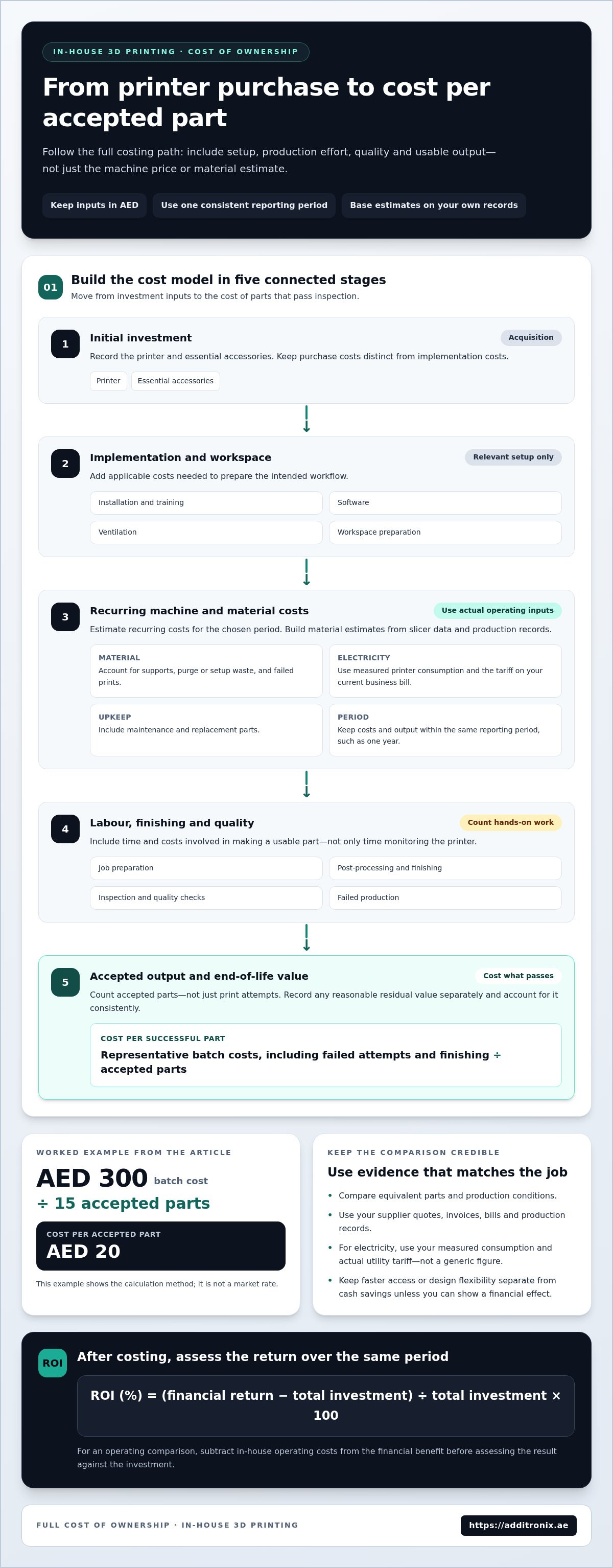
A printer’s purchase price is only the starting point. A defensible cost model includes setup, materials, machine use, people’s time, quality checks and eventual replacement or resale. This broader total cost of ownership approach helps prevent a low material estimate from hiding the real expense of producing usable parts.
Keep every input in AED and use one consistent reporting period, such as a year, across costs and output. For electricity, use measured printer consumption and the tariff on your business’s current bill. Rates can depend on the provider, emirate and account category, so avoid applying a generic figure to your model.
What belongs in the initial investment?
Separate purchase costs from implementation costs so each assumption is easy to review. Record the printer and essential accessories, then add applicable installation, training, software, ventilation, workspace preparation and other setup needs. Include only costs relevant to your intended workflow. If the equipment may retain value at the end of the evaluation period, record a reasonable residual value separately and account for it consistently.
How do you calculate recurring production costs?
Track material from slicer estimates, then adjust for supports, purge or setup waste and failed prints using production records. Add electricity, hands-on operator time, maintenance, replacement parts, finishing and inspection. Count the labour needed to prepare jobs and post-process parts, not just time spent monitoring the printer.
To find cost per successful part, total the costs for a representative batch, including failed attempts and finishing, then divide by the number of accepted parts. If a batch costs AED 300 to produce and inspection approves 15 parts, the cost is AED 20 per accepted part. This example illustrates the method, not a market rate.
Cost worksheet: Populate each line with your own quotes, bills and production records.
- 1. Initial investment: Record equipment and essential accessories.
- 2. Implementation: Add relevant setup, installation, training, software and workspace costs.
- 3. Recurring operations: Estimate material, electricity, maintenance and replacement parts for the chosen period.
- 4. Labour and quality: Include job preparation, post-processing, inspection and the cost of failed production.
- 5. Output and residual value: Count accepted parts, calculate cost per successful part, and record any end-of-life value separately.
For calculating ROI for in-house 3D printing UAE businesses, this worksheet turns estimates into assumptions you can test against actual production. Explore 3D printers and materials that can be matched to your expected workload and part requirements.
How to compare in-house printing with outsourcing fairly
A useful comparison starts with the same part, not a generic price per gram or a printer’s headline performance. Match the part’s material requirements, quantity, tolerances, finish, inspection criteria and delivery expectations on both sides. Then compare the supplier’s actual quote or invoice with your calculated in-house cost for accepted parts, including setup and finishing effort.
This like-for-like method is central to calculating ROI for in-house 3D printing UAE businesses can defend. Use recurring jobs with reliable demand and known outsourced specifications. Exclude work that needs a process, material performance or certification the proposed printer cannot deliver. If setup, supports, sanding or inspection are needed, account for them in both workflows rather than treating one option as production-ready and the other as not.
Build a comparable cost and performance view
Use one consistent quantity and reporting period, such as a typical batch and its annual demand. Populate the table with records from your own operation and supplier documentation. Keep quality assumptions visible: a lower unit cost is not a saving if the parts fail acceptance or need extra rework.
| Comparison input | Outsourced production | In-house production |
|---|---|---|
| Part and quantity | Quoted specification and batch size | Same specification and accepted quantity |
| Cost per accepted part | Quote or invoice, including setup and finishing | Material, machine operation, labour, finishing and inspection |
| Annual cost | Unit and batch costs multiplied by documented demand | Annual operating costs plus relevant setup allocation |
| Lead time | Quoted production and delivery timing | Job preparation, print time and post-processing |
| Quality assumptions | Supplier tolerances, finish and acceptance criteria | Measured output, inspection results and rework records |
Apply UAE-specific inputs carefully
Use your business’s electricity bill to identify the applicable tariff, and use the rate for your provider, emirate and account category. Don’t assume one UAE tariff applies to every site. Record the location and delivery assumptions behind supplier quotes too, since transport and timing can vary by emirate and destination.
Keep supplier, material and equipment figures in AED and apply the same tax treatment throughout the comparison. Note whether quoted amounts include applicable taxes, delivery, setup or finishing, and treat in-house costs consistently. This keeps the model auditable and makes changes in demand, location or quote terms easier to test.
Finally, report cash savings separately from operational advantages. Reduced waiting, faster design iteration or less exposure to supply disruption may matter, but quantify them only when you can connect them to a measurable outcome such as reduced downtime or documented labour hours. Otherwise, present them as supporting benefits, not guaranteed savings.
How to test payback, break-even volume, and ROI assumptions
A printer can look economical under ideal conditions and disappoint at the workload your team can actually sustain. Use the costs and comparable supplier records from your model to test three different questions: how much value the investment creates, how long it takes to recover the upfront cost, and how many parts must be produced to cover the costs.
Which ROI formulas should the business use?
First calculate the annual net benefit from jobs shifted in-house:
Annual net benefit = annual avoided outsourcing costs − annual in-house operating costs
Only count supplier spending that in-house production would genuinely replace. If annual net benefit is positive, estimate simple payback as follows:
Simple payback period = initial investment ÷ annual net benefit
Payback tells you how long recovery may take; it doesn’t show the total return over the investment’s life. For ROI over a chosen period, calculate (period net benefit − initial investment) ÷ initial investment × 100. Define period net benefit as financial benefits minus operating costs for that period. Keep the time frame consistent, and state whether the model is pre-tax and excludes financing. Add tax or financing effects only if you model them explicitly.
Break-even volume answers a separate question: how many parts must you produce for the cost advantage to cover fixed costs? If the outsourced cost per part exceeds the in-house variable cost per accepted part, use:
Break-even volume = annual fixed costs ÷ (outsourced cost per part − in-house variable cost per part)
Define fixed costs consistently. If you want break-even to include recovery of the printer purchase, include an annualized investment allowance in fixed costs. Don’t count it there and then add it again in the same calculation.
How can you avoid overstating the business case?
Build conservative, expected and high-utilization scenarios from documented demand, not maximum machine capacity. In each case, adjust assumptions that can change the result:
- Conservative: Lower scheduled demand, more failed prints, extra operator time and higher material waste.
- Expected: The workload and production performance supported by current records or a representative pilot.
- High utilization: Additional qualified jobs only when there’s evidence they can be scheduled and accepted.
Show every assumption, including accepted-part rates and labour time. After a pilot, replace estimates with measured material use, failures, finishing time and actual job volume. If modest changes to utilization or failure rates erase the benefit, the investment case needs more evidence before you scale.
Use your workload assumptions to compare suitable 3D printer options for your production needs.
Turn the ROI result into a printer and implementation plan
A positive ROI estimate is a starting point, not a reason to buy the largest or fastest machine available. Translate the jobs that passed your cost and quality review into equipment requirements: part dimensions, material compatibility, precision, finish, expected throughput and realistic utilization. The best fit is the setup that can reliably produce those qualified parts, not simply the one with the most capacity.
How should the ROI model guide equipment selection?
Use part requirements to narrow the workflow first. FDM can suit parts where its material options, geometry and finish meet the specification. Resin printing may fit smaller, detail-sensitive parts when the required material properties and post-processing workflow also work for the application. Compare the methods only for jobs where their capabilities are suitable, then confirm current machine specifications against the parts you plan to make.
Evaluate options across Additronix’s Bambu Lab, Creality and Elegoo ranges against your documented workload. Include compatible filament or resin, essential accessories, likely spare parts and the operator skills needed to run and finish each job. These inputs affect both production readiness and the ownership-cost model, so don’t select equipment from purchase price alone.
What should a practical first-stage rollout include?
Start with a defined group of repeatable, lower-risk parts that have known specifications and steady demand. Set a baseline for each job, then record actual material use, machine time, hands-on labour, failures, finishing and accepted output. That evidence will show whether your assumed utilization and cost per successful part hold up in day-to-day production.
Plan installation and operator training as part of implementation. A consistent workflow for preparing files, selecting materials, setting print parameters, handling failed jobs and inspecting finished parts makes results easier to reproduce. Add material sourcing and routine maintenance to the operating plan as well, so production doesn’t depend on an informal process or a single operator’s memory.
Review the pilot against the ROI model before expanding the workload. Compare measured costs and quality with the outsourced baseline, investigate differences and update your assumptions. If the result remains viable with realistic demand and operating effort, expand in stages. If it weakens, refine the workflow or reassess the eligible jobs before adding capacity.
Use the findings from calculating ROI for in-house 3D printing UAE to shape an equipment and support plan around actual production needs. Explore Additronix 3D printers and materials, with installation and training to support a considered move to in-house production.
Build Your Next Step on Real Production Data
A sound printer investment starts with a clear use case, not a headline speed or an optimistic capacity estimate. Compare equivalent parts using your actual supplier records, then include the full cost of ownership, from setup and labour to failed prints and finishing. Test annual net benefit, payback and break-even volume against realistic demand, and update your assumptions with measured results from an initial workload.
That’s the foundation of calculating ROI for in-house 3D printing UAE businesses can use to make a confident, practical decision. The right printer and material workflow should fit the parts you need to produce, the quality they require and the utilization your team can sustain.
Additronix offers 3D printers, materials, accessories, spare parts and 3D scanners from brands including Bambu Lab, Creality, Elegoo and Polymaker, alongside installation and training to support equipment adoption. Nationwide UAE delivery helps bring the setup to your operation. Explore Additronix 3D printers, materials and support, then use your production data to plan a capable in-house workflow.
Frequently Asked Questions
How do you calculate ROI for in-house 3D printing?
Calculate ROI by comparing the net financial benefit over a defined period with the full initial investment. Estimate the outsourcing costs that in-house production will actually avoid, then subtract operating costs such as materials, electricity, labour, maintenance, failed prints and finishing. Divide the period’s net benefit, after subtracting the initial investment, by the initial investment and multiply by 100. State your reporting period and assumptions clearly, and calculate simple payback separately.
Is in-house 3D printing cheaper than outsourcing in the UAE?
It can be cheaper for repeatable jobs, but the result depends on demand, part specifications, printer utilization, labour, material use and supplier pricing. For calculating ROI for in-house 3D printing UAE operations, compare equivalent parts and finishing requirements using actual supplier quotes in AED and your business’s electricity costs. Model low, expected and high demand scenarios rather than relying on generic market averages or assuming the printer will run at full capacity.
What costs should be included when calculating 3D printing ROI?
Include the printer, required accessories and setup, plus applicable installation, training, software or workspace preparation. Recurring costs can include materials, electricity, operator time, maintenance, replacement parts, failed prints, post-processing and inspection. Separate one-time investment from operating expenses, and use the same reporting period for costs and expected benefits. Include workspace or software costs only when they apply to the proposed workflow.
How do I calculate the break-even point for a 3D printer?
First calculate the cost difference per accepted part: outsourced cost minus in-house variable cost, using equivalent specifications and finishing. Then divide annual fixed costs by that per-part saving to estimate the annual break-even volume. This calculation works only if the outsourced cost is higher. If the in-house cost per part is equal to or greater than outsourcing, the model doesn’t show a cost-based break-even at higher volume, so review the assumptions or business case.
How long does it take for an in-house 3D printer to pay for itself?
There’s no universal payback period. Divide the initial investment by positive annual net benefit, calculated from avoided outsourcing costs minus annual in-house operating costs. Use documented demand and include the full cost of producing accepted parts. If the annual net benefit is zero or negative, the model doesn’t show simple payback. Test lower utilization and higher failure or labour assumptions before treating an estimate as a purchasing forecast.
Which 3D printing jobs are most suitable to bring in-house?
Start with recurring parts that have known specifications, reliable demand and documented outsourced costs. Prototypes, jigs, fixtures, low-volume components and replacement parts may be candidates if the proposed printer can meet their material, geometry, finish and quality needs. Set aside jobs that require processes or approvals your planned workflow can’t support. Validate promising candidates with a controlled pilot and record accepted output, failures and labour time.
How does UAE electricity cost affect 3D printer ROI?
Electricity is an operating cost, so use your business’s actual bill and applicable tariff rather than a national average. Rates and account arrangements can vary by emirate, provider and customer category. Estimate printer consumption from reliable machine data or measured operation, then apply the relevant rate for the same reporting period as your other costs. Include this amount in production costs and, where useful, allocate it across accepted parts.