
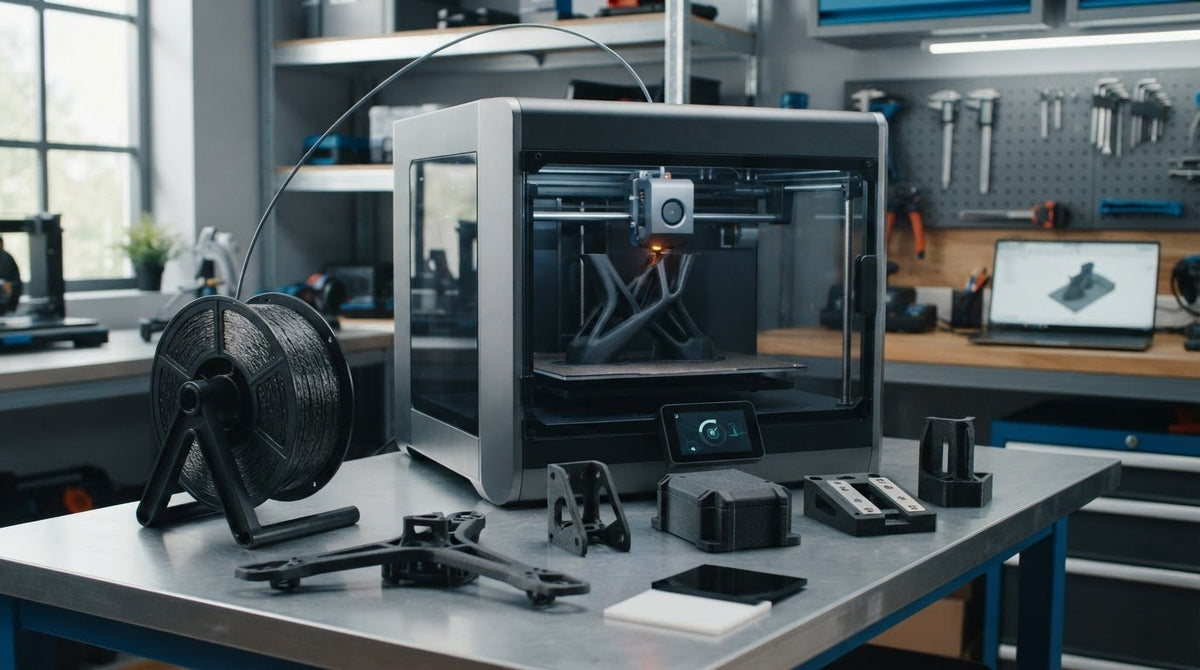
A carbon-fiber label doesn’t automatically make a printed part stronger, tougher, or suitable for every job. So, what is carbon fiber filament used for? It can suit parts that need to resist bending, hold their shape, or stay lightweight, such as functional prototypes, jigs, fixtures, equipment housings, and some drone or robotics components.
The benefits can be confusing because stiffness, strength, and durability are different properties. The base polymer matters as much as the fibers: PLA-CF, PETG-CF, and Nylon-CF have different heat resistance, toughness, and printing requirements. Chopped fibers can also increase nozzle wear and the risk of clogs.
This guide explains how to match a carbon-fiber-filled filament to a part’s requirements, what its properties mean in a finished print, and where its limits matter. You’ll also learn how to compare base polymers, account for print orientation and nozzle wear, and check that your printer setup is compatible before you begin.
Key Takeaways
- Learn what is carbon fiber filament used for and which functional parts may benefit from its stiffness and lightweight construction.
- Compare filled and unfilled filament against the part’s needs, including the trade-offs of each polymer matrix.
- Use material properties as design inputs, not guarantees of strength or durability.
- Before printing, follow the specific filament and printer documentation for compatible hardware and settings.
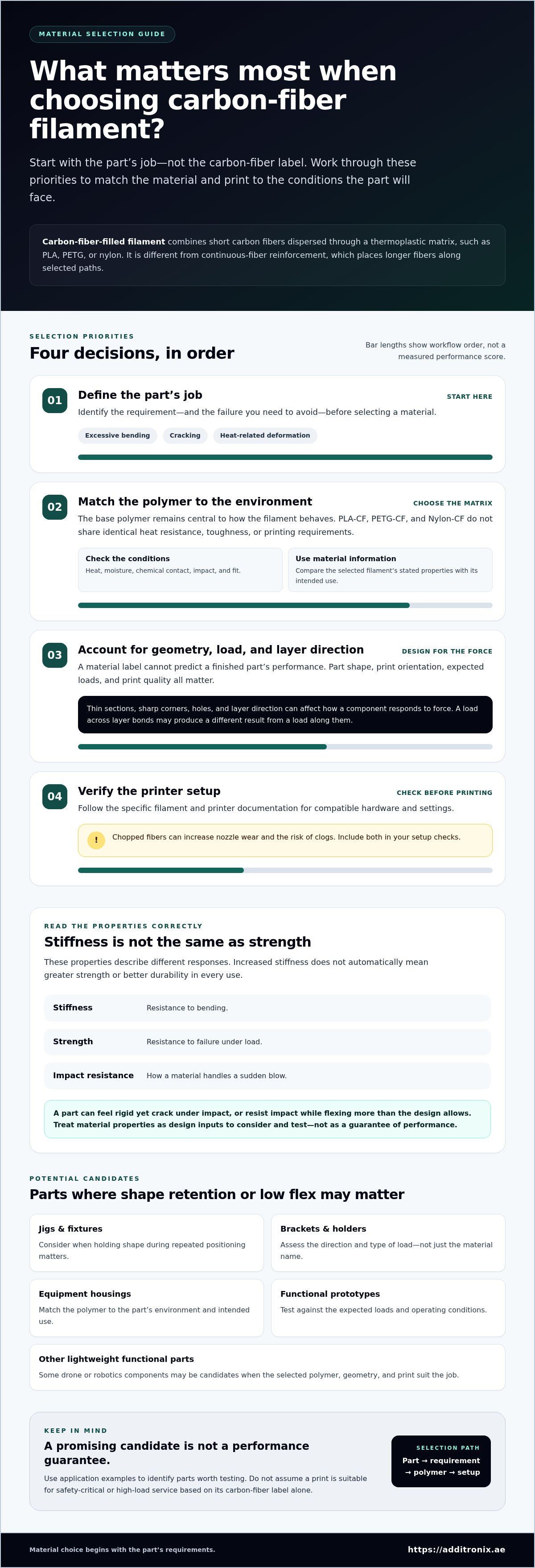
- Choose material in a clear sequence: define the part, identify its main requirement, select a polymer, then verify your setup.
What Is Carbon Fiber Filament Used For in 3D Printing?
Carbon-fiber filament combines short carbon fibers with a thermoplastic such as PLA, PETG, or nylon. The resulting composite may be useful when a part needs to flex less, retain its dimensions, or have a matte surface. If you’re asking what is carbon fiber filament used for, common candidates include jigs, fixtures, brackets, tool holders, equipment housings, prototypes, and other lightweight functional parts.
These are starting points, not automatic engineering recommendations. Performance depends on the polymer matrix, part geometry, print orientation, and expected loads. A small bracket that needs to resist bending has different requirements from a housing exposed to heat or repeated impacts. Carbon-fiber filling is one design consideration, not proof that a part will withstand a particular force or environment.
What does “carbon-fiber-filled” mean?
In filled filament, short carbon fibers are dispersed through a polymer matrix, the plastic that binds the material and forms the printed part. The fibers are mixed into the filament rather than laid continuously through the part. Continuous-fiber reinforcement places longer fibers along selected paths, so it is a different reinforcement approach. For background on carbon fiber itself, see Carbon Fibers on Wikipedia.
Filled filaments can affect stiffness, dimensional behavior, and surface appearance, but results vary with the formulation and print. The material label alone cannot tell you how a finished part will perform. Review the specific filament’s technical information and consider the part’s loads before treating it as a functional replacement for another material.
Which printed parts can benefit from it?
Start with the job the part needs to do. A jig or fixture may benefit from holding its shape during repeated positioning. A tool holder or equipment housing may be a candidate when reduced flex or a matte finish supports the design. Brackets and lightweight prototypes can also be tested, provided their expected loads and operating conditions suit the selected polymer and print.
Stiffness is resistance to bending; strength is resistance to failure under load. A part can feel rigid without being tough or reliably strong in every direction. FDM parts are built in layers, so orientation and geometry matter. Thin sections, sharp corners, holes, and layer direction can all affect how a component responds to force.
- Jigs and fixtures: Consider them when shape retention and repeatable positioning matter.
- Brackets and holders: Assess the direction and type of load, not just the material name.
- Housings and prototypes: Match the polymer to the part’s environment and intended use.
Use these examples to identify parts worth testing, not to assume a print is suitable for safety-critical or high-load service. First identify the failure you need to avoid, such as excessive bending, cracking, or heat-related deformation. Then choose a polymer and design around that requirement. This application-first approach helps distinguish a useful composite part from one chosen for its label alone.
How Carbon-Fiber Filament Changes a Printed Part
Carbon-fiber-filled filament is a composite, not a separate polymer family. Its polymer matrix, the plastic that binds the material and forms each printed layer, still shapes much of the part’s behavior. Short carbon fibers dispersed through that matrix can affect stiffness, dimensional behavior, and surface appearance. The result depends on the base polymer, fiber formulation, print orientation, and part design.
That distinction matters because a carbon-fiber label doesn’t describe a finished part’s full performance. Two filaments with different polymer bases can behave differently, even if both contain carbon fibers. A suitable material can also underperform if the part’s shape, layer direction, or print quality doesn’t suit the loads it will face.
Stiffness, strength, and impact resistance are different
Stiffness describes resistance to bending; strength describes resistance to failure under load. Impact resistance is different again: it concerns how a material handles a sudden blow. A part may feel rigid yet crack under impact, or resist impact while flexing more than the design allows. Increased stiffness therefore doesn’t automatically mean greater strength or better durability in every use.
In fused-filament printing, parts are built from layers, so the direction of a load relative to those layers can affect the outcome. A bracket loaded across its layer bonds may respond differently from one loaded along them. Treat material properties as design inputs to consider and test, not a promise that a printed component will handle a particular force.
Why the base polymer still matters
Carbon fibers modify a material formulation; they don’t replace sound design or erase the base polymer’s characteristics. PLA, PETG, ABS, and nylon are distinct polymer families with different trade-offs. A PLA-based composite may suit a different operating environment from a nylon-based one. PETG and ABS also have their own performance and processing profiles, while nylon’s moisture sensitivity can affect handling and printing.
Match the polymer to the conditions the part will face. Consider heat exposure, moisture, chemical contact, impact, and the fit the part needs. Don’t assume that all carbon-fiber-filled materials tolerate these conditions equally. Fiber content and formulation can influence the result, but the matrix remains central to how the filament behaves.
- For heat: Compare the selected filament’s stated temperature-related properties with the part’s environment.
- For moisture: Review material handling guidance, especially for moisture-sensitive polymers.
- For chemical exposure: Look for data specific to the substance and filament formulation.
Quote-ready takeaway: Filled filament changes a material formulation; it doesn’t replace sound design. Compare exact properties using the filament maker’s technical data rather than relying on broad polymer labels. As you refine a material-and-printer workflow, you can also explore 3D-printing equipment and materials as connected parts of the process.
Carbon-Fiber Filament vs Standard Filament: Which Fits the Part?
Carbon-fiber-filled filament isn’t automatically the better option. It may be useful when reduced flex or a particular surface finish serves the design, but added fibers bring trade-offs, including increased nozzle wear and material-specific printing demands. Standard filament may be the more practical choice when its properties already meet the part’s needs.
Use this comparison to narrow the options, then consult the technical data for the exact filament. A polymer name identifies a material family, not a guarantee of performance across every formulation.
| Part need | Candidate polymer | Potential benefit | Trade-off |
|---|---|---|---|
| Lower flex in a fixture or functional prototype | PLA or PETG, filled or unfilled | A filled formulation may increase stiffness and provide a matte appearance. | Stiffness doesn’t guarantee impact resistance; filled filament is abrasive. |
| A housing that faces heat | Choose a polymer based on its documented temperature properties | A suitable matrix can better match the part’s operating environment. | Carbon fiber doesn’t make a low-heat-resistance polymer heatproof. |
| Repeated handling or impact | Compare unfilled and filled PETG, ABS, or nylon formulations | The right polymer may suit the part’s toughness and use conditions. | Impact behavior varies by formulation, geometry, and print quality. |
| A simple cover or non-load-bearing prototype | Standard PLA or another suitable unfilled filament | Can meet the requirement without adding reinforcement. | May flex more than a filled alternative, depending on design. |
When might carbon-fiber-filled filament make sense?
Consider it when limiting flex is a main requirement and the selected polymer also suits the part’s environment. A fixture that must retain its shape during positioning, a functional prototype with a stiffness target, or a lightweight housing may be worth evaluating. These are examples, not validated recommendations. Check heat, impact, wear, and chemical exposure, then test the part under representative conditions before relying on it.
When is standard filament more practical?
If the part doesn’t need added stiffness, standard filament may meet the function with fewer material and setup demands. It can also make sense for early prototypes, covers, and other parts where the possible benefits of a carbon-filled formulation don’t justify its added cost. Compare the exact properties and printing guidance rather than assuming filled material is stronger or more durable.
Ask what the part must do, then identify the most likely failure: excessive bending, impact damage, heat deformation, or wear. Choose the material for the part’s main performance requirement, not for the carbon-fiber label. This keeps the decision focused on the finished component and helps balance function, printability, and material cost.
How to Prepare Your Printer and Part Design for Carbon-Fiber Filament
Your answer to “what is carbon fiber filament used for” should guide both material selection and print preparation. Don’t transfer settings from another brand or polymer just because its spool also says carbon fiber. Use this pre-print checklist to match the filament, printer, and part before committing to a longer print or production run.
Check material, nozzle, and printer requirements
Start with the exact filament’s technical data and your printer’s documentation. Confirm the base polymer, recommended operating conditions, and nozzle requirements. Carbon fibers can be abrasive and wear some nozzle materials, but guidance varies by formulation and printer. Don’t assume one brand’s temperature range, bed settings, or hardware recommendations apply to another.
- Identify the material. Confirm the polymer and find the manufacturer’s recommended nozzle temperature, bed settings, and any drying or storage instructions. Use the exact filament documentation, not a generic profile for a similar material.
- Check printer compatibility. Compare the filament maker’s requirements with the printer documentation. Confirm the nozzle material and configuration are suitable, and check any stated limits for the hot end or build surface.
- Prepare the print profile. Use the manufacturer’s settings as a starting point. Avoid guessing or copying values from another carbon-fiber-filled filament; adjust only through controlled test prints and documented guidance.
- Review the part’s fit and orientation. Check clearances, mating surfaces, and the direction of expected loads. Orient the part so its layers suit those forces, then consider whether the design needs more material around fasteners or other stress points.
- Test before scaling up. Print a representative sample or prototype. Check fit, surface quality, and performance under safe, intended-use conditions before making more parts.
Design for the forces the part will face
Layer direction matters because a printed part can respond differently to loads applied along the layers versus across their bonds. Consider where force enters the part, especially around holes, corners, and fasteners. Adjust orientation and wall count through small test prints, then evaluate the actual design. A successful prototype can inform the next iteration, but it doesn’t validate performance in every operating environment.
Record the filament, printer, profile, orientation, and design changes used for each test. This makes it easier to identify what improved fit or performance instead of changing several variables at once. For a part that carries a critical load, don’t rely on appearance or a single successful print as proof of suitability.
Build your setup around compatible hardware, materials, and practical know-how. Explore 3D-printing equipment and training to support your next material and workflow decision.
Choose Your Next 3D-Printing Material with a Clear Use Case
A good material choice starts with the part, not the filament label. If you’re still asking what is carbon fiber filament used for, the practical answer is to use it when the part’s requirements make its specific properties worthwhile. Carbon-fiber filling is one attribute of a material, not a complete engineering specification. Polymer, geometry, print setup, and operating conditions all shape the result.
Use this decision sequence before choosing a spool:
- Define the part: Write down its function, fit requirements, and expected use.
- Identify its main demand: Decide whether the priority is stiffness, impact resistance, heat tolerance, appearance, or another property.
- Choose the polymer: Compare candidate materials using the selected filament manufacturer’s technical data.
- Verify the setup: Match the printer, nozzle, and print profile to the exact material’s guidance, then test the part.
This sequence keeps the decision focused. If reduced flex matters most, compare suitable filled and unfilled options. If heat, moisture, or impact is the key concern, first check how the base polymer and specific formulation perform in that environment.
Turn the application into a material brief
Make the requirements concrete before comparing materials. Record what the part does, the direction and type of load it will face, its operating environment, and any fit or finish needs. Use manufacturer data to compare relevant properties, not just broad polymer names. Then print a representative test, note the material and settings, and record how the part performs. This gives you a repeatable basis for refinement.
Build a supported 3D-printing workflow
Material selection works best as part of a complete process: printer capability, filament, slicer settings, part design, and testing need to work together. A change in one can affect the finished output, so document revisions and test under intended-use conditions before relying on the part. Additronix brings 3D printers, filament materials, installation, and training together as parts of a broader workflow, helping users build practical printing skills alongside their equipment and consumables.
Start with a clear use case, make one considered material choice, and learn from the first test print. To explore equipment and materials for your next project, browse Additronix’s 3D-printing range.
Make Your Next Print a Purposeful Test
Turn your next material decision into a focused experiment. Choose one part and define what success looks like before printing: a secure fit, less flex, a clean finish, or dependable function in its intended environment. Then record the material and setup so you can learn from the result and make the next iteration with purpose.
The question “what is carbon fiber filament used for” is most useful when it leads to a specific application, not a material chosen for its label alone. Let the part’s priorities guide your investigation, and treat each prototype as a chance to build practical knowledge. That approach can help you make more considered choices across future projects, whether you’re refining a familiar workflow or exploring a new material category.
Good results come from bringing the right equipment, consumables, and know-how together. Additronix’s 3D-printing range includes printers, filament materials, and accessories, with installation and training to support users as they develop their workflows. Explore Additronix 3D printing equipment and materials, and take your next idea from a considered material choice to a purposeful print.
Frequently Asked Questions
Is carbon-fiber filament electrically conductive?
It can conduct electricity, but don’t assume every carbon-fiber-filled filament or print will behave as a dependable conductor. Conductivity depends on the specific formulation and how fibers connect within the printed part. A plastic composite isn’t a substitute for a designed electrical component. For a project involving current, grounding, or electrical safety, use data for the exact filament and test the finished part appropriately.
Can carbon-fiber filament be used for food-contact parts?
Don’t assume a carbon-fiber-filled print is suitable for food contact. The question “what is carbon fiber filament used for?” describes possible applications, not food-contact safety. The filament’s ingredients and the finished object’s manufacturing conditions both matter, and FDM layer lines can create crevices that are difficult to clean. Use only a material and finished-part process specifically documented for the intended food-contact use.
Can carbon-fiber filament be used outdoors?
It can be considered for outdoor parts, but the base polymer and the part’s exposure determine suitability. Sunlight, temperature changes, rain, and chemical exposure can affect materials differently, and carbon-fiber filling alone doesn’t establish weather resistance. A sheltered mounting cover has different demands from a component exposed to direct sun year-round. Review the exact filament’s UV and environmental data before choosing it.
Can a carbon-fiber-filled 3D print be recycled?
Recycling may be possible, but don’t assume the print belongs in a standard household recycling bin. Carbon fibers are combined with a polymer, and local recycling programs may not accept filled or mixed plastics. Check the material identification and your local facility’s accepted items. For workshop scraps, keep different polymer types separate where practical, and follow local waste guidance rather than placing them in a recycling stream by guesswork.
How should carbon-fiber filament be stored?
Follow the filament maker’s storage instructions, and protect the spool from moisture when it isn’t in use. A sealed bag or storage container with suitable desiccant can help limit exposure, while a label makes it easier to track the material and opening date. If a spool has absorbed moisture, use only the drying conditions specified for that filament. Excessive heat can damage some polymers, so avoid improvised drying settings.
Can carbon-fiber filament be sanded or finished after printing?
Yes, some prints can be sanded or otherwise finished, but test the process on a sample first. Abrasion may change the matte surface, reveal fibers, or affect a thin wall’s dimensions. Avoid creating or breathing dust; use suitable protective equipment and collect debris safely. For parts that need precise mating surfaces, protect those areas during finishing and recheck the fit afterward.
Does carbon-fiber filament need a special nozzle?
Often, it needs a wear-resistant nozzle because carbon fibers can abrade some nozzle materials, including standard brass. Check the exact filament and printer documentation for the required nozzle type and compatible hardware. A worn nozzle can change extrusion and affect print consistency, so inspect it if quality changes over time. Don’t assume all carbon-fiber formulations have identical requirements or use the same printer settings.