

Why does a flawless digital design so often transform into a warped, brittle, or sticky mess the moment it leaves the printer? If you've struggled with failing supports or losing fine details, the culprit isn't always your hardware. Finding the right 3D printing resin UAE professionals and hobbyists can trust is the true secret to unlocking high-resolution output. The local climate adds another layer of complexity; the extreme heat and humidity in the Middle East can quickly degrade sensitive materials before you even start your first layer.
We understand how overwhelming it is to choose between standard, tough, and water-washable variants while worrying about local stock availability. This guide simplifies that process by matching specific resin types to your project's mechanical needs. You'll learn how to safeguard your materials against the elements and where to source premium brands like Elegoo and Creality from a reliable local partner. We're covering everything from material science to UAE-specific storage tips to ensure your next print is your best one yet.
Key Takeaways
- Learn how to match resin chemistry to your specific project needs, whether you require high-detail visual models or durable functional prototypes.
- Protect your materials from the local climate by mastering storage techniques that prevent heat-induced degradation and humidity-related print failures.
- Identify the best sources for high-quality 3D printing resin UAE professionals trust, ensuring consistent stock of premium brands like Elegoo and Creality.
- Explore the performance differences between reliable workhorses like water-washable resins and high-precision resins optimized for modern LCD hardware.
- Discover how professional local support and fast nationwide delivery can streamline your manufacturing workflow and reduce downtime.
Understanding 3D Printing Resin: Why Material Choice Matters
In the high-stakes environment of additive manufacturing, your choice of 3D printing resin UAE supplies is the single most important factor for success. Unlike filament, which relies on melting plastic, resin is a photopolymer. It changes state from liquid to solid through a chemical reaction triggered by specific light wavelengths. This transformation dictates every physical attribute of your final part, from the smoothness of the surface to the structural integrity of the internal bonds. Selecting the right material isn't just about compatibility; it's about engineering the outcome of your project before the first layer even cures.
The Science of UV Curing
Most modern desktop printers use 405nm light to trigger photoinitiators within the liquid resin. This process, fundamentally based on Stereolithography (SLA) technology, requires absolute wavelength compatibility. If your resin's curing profile doesn't align with your printer's light source, you'll experience failures like "elephant's foot" or incomplete layer adhesion. Viscosity also plays a vital role in this cycle. Lower viscosity resins flow more quickly across the build plate, which allows for faster lift speeds and better detail retention in complex, tight geometries. High-quality resins manage this balance perfectly, ensuring consistent flow even in the controlled environments of professional workshops.
Resin vs. Filament: When to Choose SLA
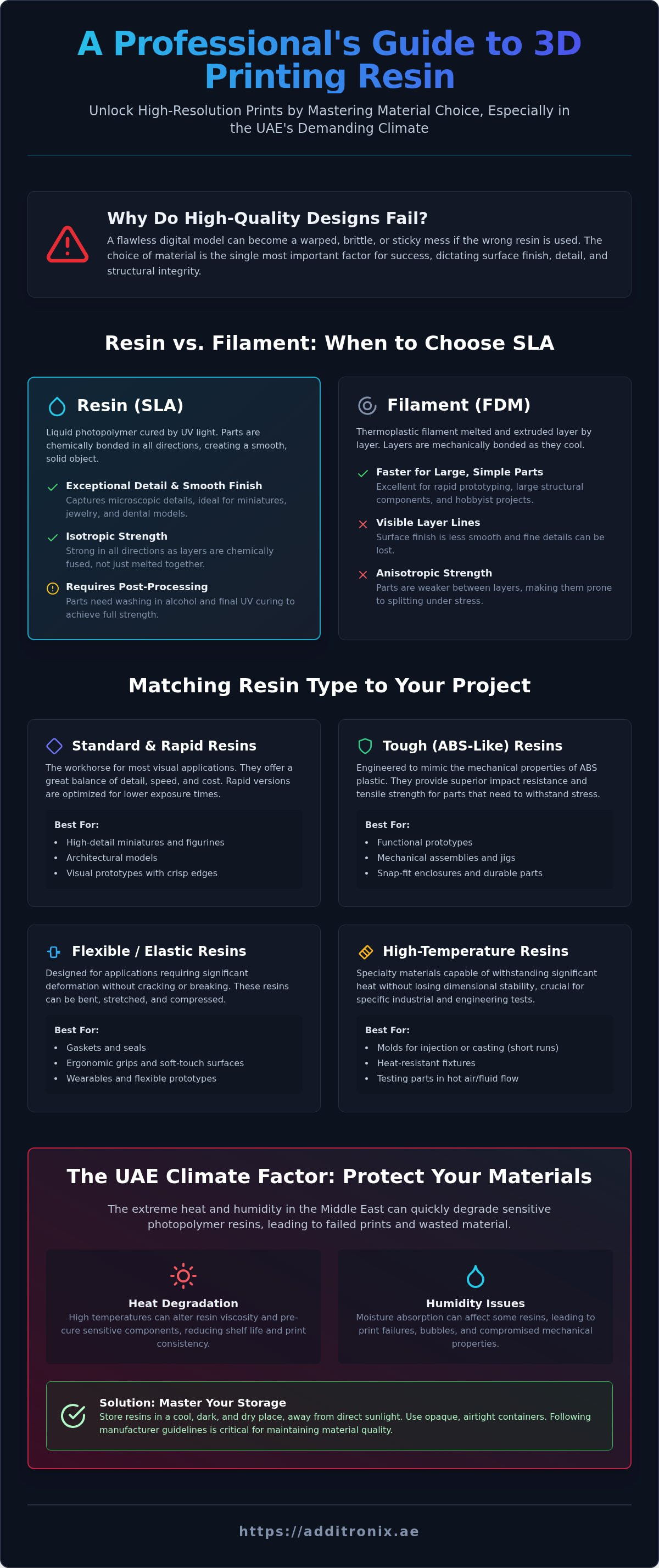
Why should you choose resin over a high-speed FDM setup like the Creality K1 Max? The answer lies in isotropic strength. While filament prints have inherent weak points between layers, resin parts are chemically bonded in all directions. This makes resin the non-negotiable choice for industries requiring absolute precision, such as jewelry casting, dental models, and high-detail miniatures. You get a level of detail that FDM simply cannot match. However, it's vital to remember that resin requires a disciplined post-processing workflow. Every part needs a thorough wash in isopropyl alcohol and a final UV cure to reach its rated mechanical strength.
Investing in premium materials is the most cost-effective way to upgrade your hardware's performance. High-quality formulations offer a superior balance between exposure time and resolution. While bargain resins might seem attractive, they often require longer cure times, which increases wear on your printer's LCD screen over time. By selecting professional-grade resins, you ensure better layer adhesion and a surface finish that feels like a finished product right out of the vat. This reliability is essential for maintaining a productive workflow in the UAE's growing tech sector.
Comparing Resin Types: Standard, Tough, and Specialty
Identifying the ideal 3D printing resin UAE suppliers provide involves more than just checking compatibility. You must align the material's chemical profile with the intended use of your print. The local market offers a diverse range of options, from budget-friendly standard liquids to high-performance engineering polymers. Understanding these differences ensures you don't waste time on failed prints or brittle parts that can't survive their first use.
Standard and Rapid Resins
Standard resins from authorized distributors like Elegoo and Creality serve as the foundation for most projects. These materials excel at capturing intricate details for figurines and architectural models. They offer a crisp finish that requires minimal sanding or filing. If your workflow prioritizes speed, rapid resins are the solution. These formulations are engineered for lower exposure times, which is perfect for high-speed machines like the Elegoo Saturn 3 Ultra. While they accelerate the production cycle, they maintain the sharp edges and fine textures required for professional-grade visual prototypes.
Functional and Engineering Resins
High-performance engineering resins bridge the gap between hobbyist prints and industrial-grade components. Tough resins are specifically formulated to mimic the properties of ABS plastic. They provide the impact resistance and tensile strength needed for mechanical assemblies or snap-fit parts. For applications requiring flexibility, elastic resins allow for significant deformation without cracking, which is ideal for gaskets or ergonomic grips. Additionally, high-temperature resins are available for industrial testing, capable of withstanding significant heat without losing dimensional stability. Because these chemical compounds can be sensitive to ambient conditions, it's vital to adhere to safety guidelines for flammable resins, especially when storing them in the region's high temperatures.
Water-Washable and Specialty Options
Water-washable variants are designed to streamline the user experience for everyone from students to professional designers. These materials allow you to clean your prints with simple tap water instead of volatile isopropyl alcohol. This makes them a preferred choice for schools, offices, and home workshops where ventilation might be limited. Despite the easier cleanup, the output remains high-quality with low shrinkage rates. Transitioning to these specialized materials can significantly reduce your post-processing overhead and chemical handling requirements. To get started with the right material for your next innovation, you can browse our full selection of resins to ensure you're using the best tools for the job.
The UAE Factor: Resin Storage and Safety in the Heat
Managing your material inventory requires extra diligence when operating in the Middle East. The ambient conditions in the Emirates can be brutal on sensitive chemicals. When working with 3D printing resin UAE enthusiasts must account for both extreme thermal peaks and high humidity levels. Heat acts as a catalyst for the chemical components within the bottle. If left in an uncooled environment, the resin can begin to partially polymerize or lose its original viscosity, leading to inconsistent prints and blocked filters. Humidity is equally disruptive, as moisture absorption can compromise the resin's chemistry, resulting in surface defects or brittle finished parts.
Climate-Controlled Storage Tips
Maintain a stable environment to preserve your material's shelf life. The ideal temperature for storing most resins is between 20°C and 25°C. Even a few hours in a hot vehicle or a non-air-conditioned room can trigger premature degradation. Always keep your bottles in a dedicated, dark cabinet. Never store resin near windows, as even indirect sunlight contains enough UV energy to start the curing process through the plastic. For opened bottles, ensure the caps are tightened immediately after use. If you operate in coastal areas with high humidity, consider using airtight storage bins with silica gel packets to keep the air around your supply dry.
Safe Handling and Disposal in the UAE
Safety is the foundation of any professional workshop. Liquid resins are skin irritants and can release volatile organic compounds (VOCs) during the printing and curing stages. It's essential to understand the chemical hazards of liquid resins to protect yourself and your team. Always wear nitrile gloves and safety glasses when handling uncured material. If you're running long prints on machines like the Elegoo Saturn 3 Ultra, ensure your room has active ventilation or an air filtration system. This prevents the buildup of odors and ensures a healthy workspace for recurring projects.
Proper disposal is a critical responsibility for every user. Never pour liquid resin or contaminated wash water down the drain. In the UAE, best practices involve curing any waste resin until it's completely solid and inert. Once cured, it can typically be disposed of as standard waste. For used isopropyl alcohol (IPA), allow the resin particles to settle, filter the liquid for reuse, and cure the remaining sludge. This methodical approach protects the local environment and ensures your operation remains sustainable and compliant with safety standards. By following these protocols, you can focus on the creative possibilities of 3D printing without compromising on safety or material quality.
How to Choose: A Project-Based Buying Framework
Selecting the best liquid polymer for your workflow isn't just about brand preference; it's about matching material properties to your specific end-use case. When searching for the right 3D printing resin UAE professionals and hobbyists should adopt a "Project-First" mindset to avoid wasted material and failed assemblies. This framework ensures that your technical requirements drive your purchase decisions rather than just price points.
- Define Mechanical Needs: Determine if your part must flex under pressure or remain rigid for a static display. Brittle resins are excellent for detail but fail under impact.
- Determine Detail Level: Match the resin's resolution capability to your project. A 32mm miniature requires different flow characteristics than a large, structural industrial enclosure.
- Assess Post-Processing: Evaluate your workspace. Does it support safe IPA handling and storage, or do you require the simplified cleanup of water-washable formulations?
- Hardware Compatibility: Verify that the resin is optimized for your machine's specific light source. Formulations designed for the high-intensity monochrome LCDs in the Elegoo Saturn 3 Ultra may behave differently on older DLP systems.
Best Resins for Miniatures and Gaming
For hobbyists and professional painters, high-detail standard resins are the industry gold standard. These formulations offer the highest resolution for organic textures and sharp edges, making them ideal for tabletop gaming. Choosing a resin with low shrinkage is vital for models with multiple interlocking components or push-fit bases. Most professionals prefer grey resins because the neutral tone acts as a perfect canvas, highlighting subtle shadows and intricate details that might be lost in translucent or black materials. This visual clarity is essential for identifying print defects before you begin the painting process.
Best Resins for Functional Prototypes
When your output needs to perform in the real world, engineering-grade resins are essential. Tough resins are engineered to mimic the properties of ABS or polypropylene, providing the impact resistance necessary for snap-fit joints and mechanical housings. Achieving maximum material strength requires a disciplined post-curing cycle after the initial print. This step ensures the polymer chains fully cross-link, giving the part its rated durability and dimensional accuracy. If you're ready to upgrade your production quality, you can shop our range of high-precision resins to find the perfect match for your next project.
Top Resin Recommendations from Additronix
Choosing the right supplier is as critical as choosing the right material for your project. Additronix serves as a premier distributor, ensuring that every bottle of 3D printing resin UAE users purchase is stored in optimal, climate-controlled conditions before it reaches their door. This local availability eliminates the risks of material degradation during long international shipping routes, where extreme heat can compromise the chemical integrity of the liquid. We focus on authorized brands like Elegoo and Creality to provide a versatile range that caters to every skill level, from hobbyist models to industrial components.
Standout Products for Beginners
We recommend starting with Water Washable resins if you're setting up a home or office workshop for the first time. These formulations remove the need for volatile chemicals like isopropyl alcohol, making the post-processing phase significantly safer and more convenient for users in confined spaces. Elegoo's Water Washable range is particularly reliable, offering consistent curing profiles and high-detail results that rival standard resins. It's the perfect way to master the fundamentals of SLA printing without the complexity of advanced chemical management. You get the sharp edges and smooth surfaces you expect, but with a much simpler cleanup process that uses standard tap water. You can browse our beginner-friendly resin collection to find the ideal starting point for your creative journey.
Advanced Materials for Professional Output
For engineering firms and industrial designers, high-precision and specialty resins are essential for creating functional prototypes that mirror real-world plastics. Creality's latest formulations are specifically optimized for modern LCD hardware, such as the Elegoo Saturn 3 Ultra, ensuring that you achieve the dimensional accuracy required for mechanical assemblies. These materials offer the surface finish and mechanical strength needed for rigorous testing and mold-making. Finding high-quality 3D printing resin UAE stockists who understand these industrial requirements is the key to maintaining a competitive edge. By sourcing these professional-grade materials locally, you maintain a lean inventory and minimize project downtime with our fast nationwide delivery. Shop professional 3D printing resins in the UAE and elevate your manufacturing capabilities today.
Mastering resin printing involves more than just pouring liquid into a vat. Additronix provides a comprehensive ecosystem of support, including professional 3D printer installation and training services. This ensures your team understands the nuances of layer exposure, support placement, and climate-specific storage. We don't just supply products; we empower you to achieve professional-grade results from your first print to your thousandth. Whether you're a hobbyist or an industrial user, our goal is to ensure your technological transition is seamless and successful.
Take Command of Your Manufacturing Quality
Mastering 3D printing resin UAE projects requires a strategic approach to material selection and environmental control. You've seen how the right polymer choice dictates everything from surface finish to mechanical strength, and how proper storage preserves that quality in our local climate. Success isn't just about owning the hardware; it's about having a reliable ecosystem of supply and support to turn digital concepts into tangible reality.
Additronix provides that foundation as an authorized distributor for Elegoo and Creality. We offer more than just premium stock; we provide fast nationwide delivery across the UAE and expert technical training to ensure you achieve industrial-grade results every time. Whether you're building functional prototypes or intricate miniatures, our team is here to help you optimize your workflow and reduce project downtime. It's time to stop troubleshooting and start creating with total confidence.
Shop Premium 3D Printing Resins at Additronix UAE and take control of your production quality today. Your next innovation is only a print away.
Frequently Asked Questions
What is the best 3D printing resin for beginners in the UAE?
Water-washable resin is the ideal starting point for beginners because it eliminates the need for volatile cleaning solvents like isopropyl alcohol. Brands like Elegoo offer consistent formulations that work reliably with entry-level hardware. This simplified cleanup process reduces the chemical handling required in your home workshop. When sourcing 3D printing resin UAE beginners should prioritize ease of use to master the fundamentals of layer exposure and support placement before moving to complex materials.
Can I mix different types or brands of 3D printing resin?
Mixing different resins is generally discouraged because each formulation has a unique chemical profile and curing speed. If you combine brands or types, you risk incomplete polymerization or layer separation during the print. While some advanced users mix tough and standard resins to adjust mechanical properties, this requires extensive calibration. It's safer to use a single, high-quality product to ensure your results remain consistent and your hardware stays protected from vat failures.
How long does 3D printing resin last once the bottle is opened?
Most photopolymer resins have a shelf life of twelve months, but this typically drops to six months once the seal is broken. In the Middle East, high ambient temperatures can accelerate this degradation if the bottle isn't kept in a climate-controlled area. Always store your open bottles in a dark, cool cabinet between 20°C and 25°C. If the resin appears lumpy or has a significantly changed odor, it's likely expired and should be replaced.
Is water-washable resin better than standard resin?
Water-washable resin is superior for user convenience and safety in home environments since it rinses off with simple tap water. However, standard resins often provide better mechanical strength and finer detail for industrial prototypes. Standard resins also tend to be less brittle than their water-washable counterparts. Your choice should depend on your project's requirements and whether your workspace is equipped to handle the volatile organic compounds associated with traditional solvent-based cleaning methods.
Why are my resin prints coming out brittle in the UAE heat?
Excessive brittleness is often caused by accidental over-curing from the intense local sun or storing liquid resin in high heat. If your liquid material is exposed to temperatures above 30°C before printing, its chemical bonds can begin to break down. Additionally, many users leave their prints in UV curing stations for too long. For the best results in the UAE, use a dedicated curing chamber and strictly monitor exposure times to prevent the polymer from becoming rigid.
Do I need a specific resin for my Bambu Lab or Creality printer?
It's important to distinguish between printer technologies because the Bambu Lab X1-Carbon is an FDM printer that uses filament, not resin. For resin printers like the Elegoo Saturn 3 Ultra, you must use 405nm UV-curable resin. While you don't always need the same brand of resin as your printer, using Creality resins on Creality hardware often provides pre-calibrated settings. Always verify that your chosen material is compatible with the specific wavelength of your machine.
How do I safely dispose of used 3D printing resin in Dubai?
Safe disposal in Dubai requires you to cure all liquid waste until it is completely solid and inert. You should never pour uncured resin or contaminated wash water into the drainage system. Place your waste resin, used paper towels, and supports in a clear container under direct sunlight until they are hard. Once fully cured, these items can typically be disposed of with regular household waste according to local environmental guidelines and safety standards.
What is the difference between SLA, LCD, and DLP resins?
The primary difference lies in how the light source interacts with the material to cure each layer. SLA uses a laser, DLP uses a projector, and LCD uses an LED array with a masking screen. Most modern 3D printing resin UAE suppliers stock is optimized for 405nm LCD printers due to their popularity. While many resins are cross-compatible, DLP resins are often formulated to cure faster due to lower light intensity. Always check the manufacturer's specifications.