
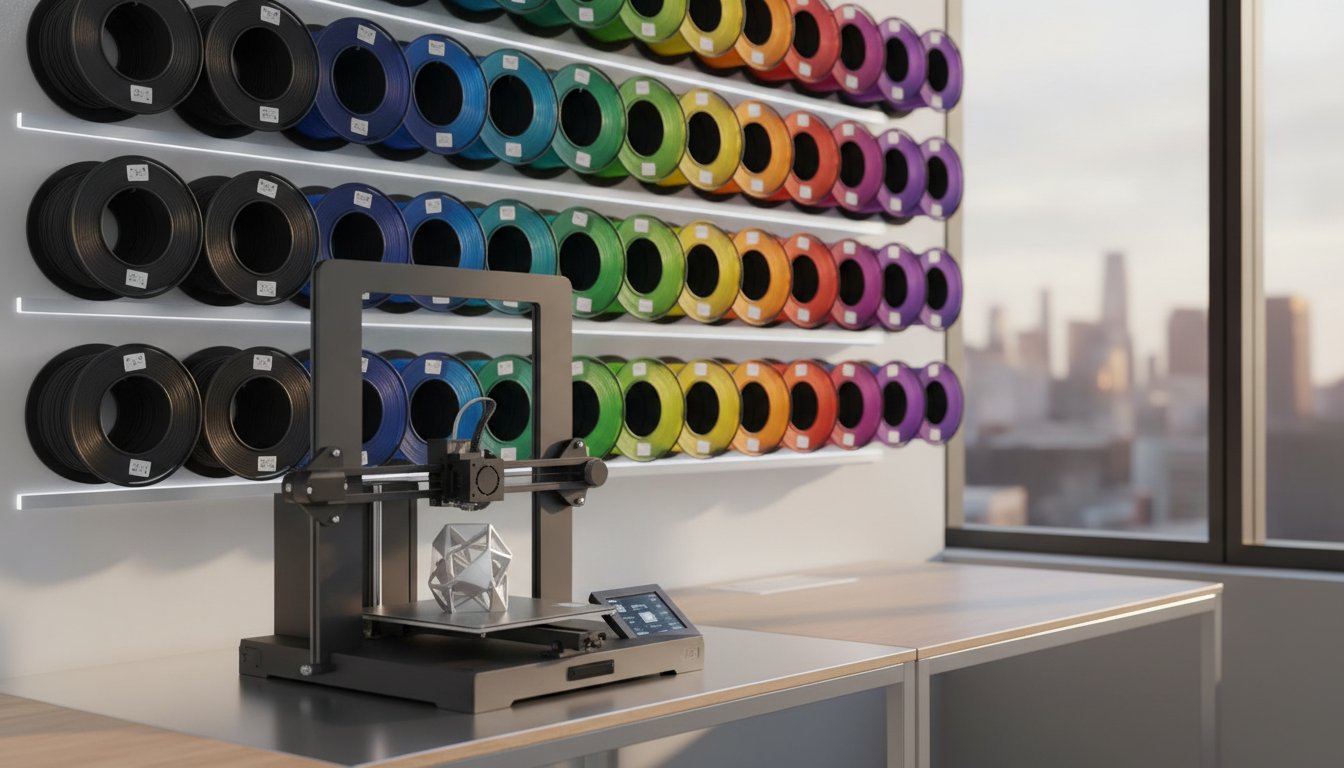
Your 3D printer is only as capable as the material you feed it. In 2026, the strategic selection of bambulab filaments transforms your machine from a hobbyist's tool into a reliable, push-button manufacturing center. It's no longer just about melting plastic. It's about achieving industrial-grade results with desktop ease. You're likely tired of watching prints warp during challenging environmental conditions or losing entire spools to "trial and error" settings that never seem to stick.
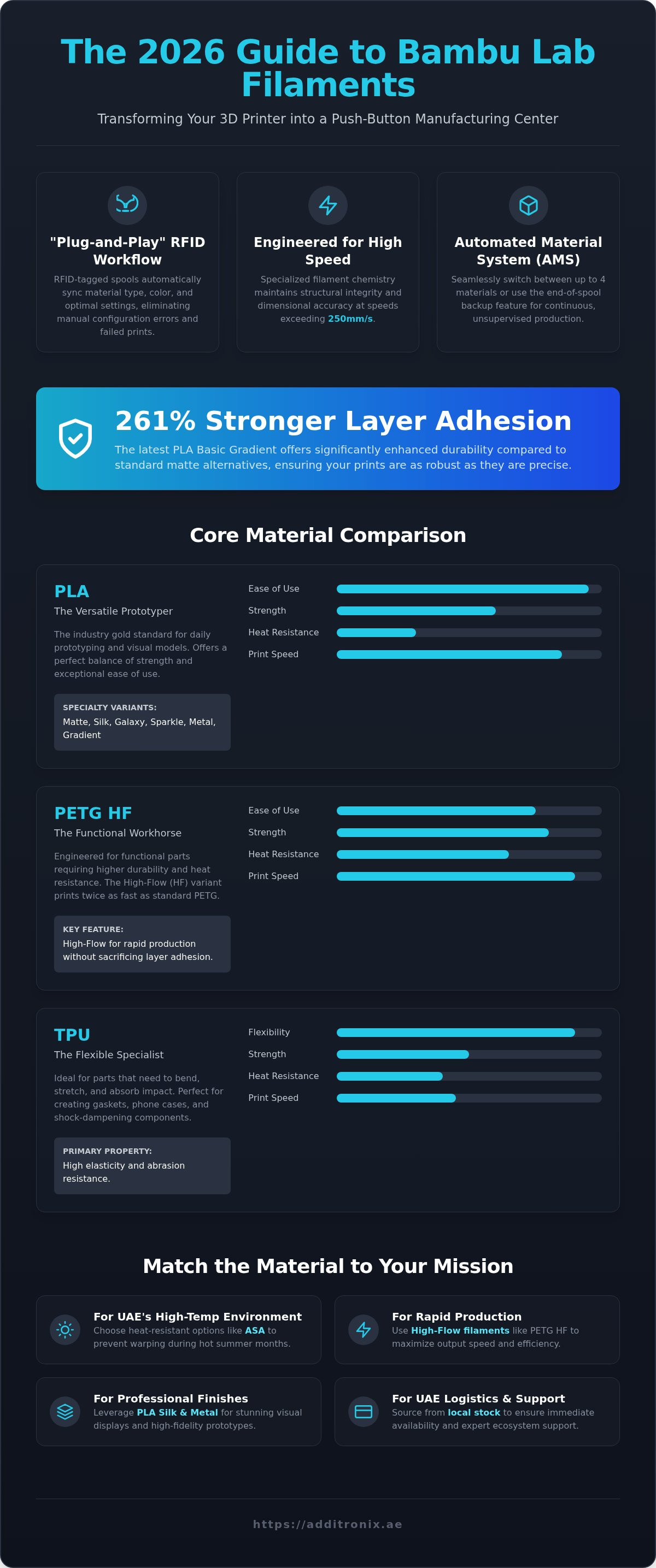
You deserve the flawless surface finishes and high-speed performance your hardware was built to deliver. This guide provides a clear roadmap to selecting the right material for any application, from beginner-friendly PLA to rugged, industrial-grade carbon fiber. You'll discover how to leverage RFID technology for automated material management via the AMS and why sourcing directly from Additronix is the best way to ensure authenticity and fast delivery. We'll break down the 2026 lineup, including why the latest PLA Basic Gradient offers 261% stronger layer adhesion than standard matte alternatives, ensuring your output is as durable as it is precise.
Key Takeaways
- Master the "Plug-and-Play" workflow by using RFID-tagged spools that automatically sync material settings with your slicer to eliminate manual configuration errors.
- Choose the ideal material for the UAE's environment, focusing on heat-resistant options like ASA to prevent warping during high-temperature summer months.
- Optimize your production speed with high-flow bambulab filaments designed to maintain structural integrity even at printing speeds exceeding 250mm/s.
- Evaluate specialized finishes like PLA Silk and Metal to achieve professional-grade results for visual displays and functional prototypes.
- Streamline your logistics by sourcing local stock in the UAE, ensuring immediate availability and expert support for your entire printing ecosystem.
Why Bambu Lab Filaments Are the Ecosystem Standard
Bambu Lab has redefined the standards for fused filament fabrication (FFF) by treating their materials as integrated hardware components rather than simple consumables. This approach eliminates the friction usually associated with 3D printing. By using bambulab filaments, you aren't just buying plastic; you're investing in a calibrated system that guarantees a specific result every time you hit print. This reliability is why professionals and enthusiasts alike are moving away from generic alternatives in favor of an all-in-one solution.
The Role of RFID and Automatic Material Recognition
Manual calibration is a relic of the past for modern workshops. Each spool of official bambulab filaments features an embedded RFID tag that the Automatic Material System (AMS) reads instantly upon loading. This system communicates the exact material type, color, and optimal print parameters to the slicer software without any user intervention. It removes the risk of using incorrect temperature or flow settings, which often lead to failed prints or clogged nozzles. Professional users in the UAE find this particularly valuable for managing large material inventories. The AMS also provides a seamless "End-of-Spool" backup feature. If one spool runs out mid-print, the system automatically switches to a secondary spool of the same material, ensuring your production continues overnight without supervision.
Engineered for High-Speed Performance
Printing at speeds exceeding 250mm/s demands more than just a fast motor; it requires specialized material chemistry. High Flow filament as a material designed with lower viscosity for rapid extrusion. These optimized materials are engineered to melt and cool at precise intervals that match the motion system's aggressive acceleration. While generic brands often struggle with under-extrusion or poor layer bonding at high speeds, official materials maintain structural integrity. The cooling rates are specifically tuned to prevent sagging on bridges and overhangs, even when the print head is moving at peak velocity. This thermal stability is essential for maintaining dimensional accuracy in functional parts.
The AMS Advantage and Professional Consistency
The ability to switch between materials seamlessly unlocks complex geometries that were previously impossible. You can combine rigid structural plastics with dedicated support materials that snap away cleanly, leaving a perfect surface finish. This integration reduces the likelihood of nozzle clogs because the diameter and roundness of the filament are held to incredibly tight tolerances. For any professional operation, consistency is the ultimate metric. Reducing the time spent on troubleshooting extrusion inconsistencies means more time focused on design and delivery. By choosing materials designed for the machine, you ensure that every print meets the same high standard of quality.
Comparing Core Materials: PLA vs. PETG vs. TPU
Choosing the right polymer is the first critical decision in your manufacturing workflow. While the hardware manages the precision, your choice of bambulab filaments defines the structural and aesthetic success of the final output. It's not just about color; it's about matching material properties to the environmental demands of your project. Understanding the mechanical differences between PLA, PETG, and TPU ensures you select a material that matches your project's intent while avoiding common pitfalls like warping or brittle failure.
Bambu Lab PLA: Basic, Matte, and Specialty
Bambu Lab PLA (AED 120) is the reliable choice for daily prototyping. It offers a balance of strength and ease of use that makes it the industry gold standard for rapid iteration. If you need to hide layer lines for architectural models or detailed figurines, PLA Matte (AED 120) provides a non-reflective finish that absorbs light beautifully, giving your prints a professional, injection-molded appearance. For projects requiring high visual impact, specialty variants like PLA Galaxy (AED 110) or PLA Sparkle (AED 130) incorporate embedded flakes that produce a premium look without the complexity of actual metal-filled materials. These specialty options are perfect for display pieces where surface finish is the primary requirement.
PETG HF: The New Standard for Functional Parts
Functional parts require more durability and heat resistance than standard PLA can provide. PETG HF (AED 130) represents a significant evolution in material science, engineered to print twice as fast as standard PETG without sacrificing layer adhesion. This high-flow capability makes it ideal for outdoor applications where UV resistance and high toughness are mandatory. For engineers looking for a deeper dive into material properties, this technical guide to engineering filaments offers a comprehensive look at how these polymers behave under mechanical stress. If your project involves light diffusion or clear windows, PETG Translucent (AED 115) is the preferred option. You'll achieve the best results by using a slightly higher nozzle temperature and lower print speeds to maximize the clarity of the internal structure.
Flexible Solutions: TPU for AMS and TPU 90A
Flexibility used to be a challenge for automated systems, but the innovation of TPU for AMS (AED 200) has solved this hurdle. This variant is stiff enough to be fed through the AMS without jamming or buckling, allowing for multi-material prints that combine rigid and flexible zones in a single job. For industrial-grade vibration dampening, custom gaskets, or protective cases, TPU 90A (AED 240) offers the resilience and impact absorption needed for harsh environments. These specialized bambulab filaments provide a string-free surface finish that significantly reduces post-processing time. To ensure you have the right material ready for your next build, explore the full range of official filaments available for immediate local delivery across the UAE.
Engineering-Grade Specialty Filaments for Professionals
The transition from aesthetic prototyping to end-use manufacturing requires a deep understanding of the properties of 3D printing materials. Bambu Lab has simplified this leap by providing pre-calibrated profiles for abrasive and high-temperature polymers that previously required hours of manual tuning. Engineering-grade bambulab filaments are designed to bridge the gap between desktop accessibility and industrial-grade performance, allowing you to produce functional parts that withstand mechanical stress and environmental extremes.
Bambu Lab Carbon Fiber (PETG-CF and PET-CF)
Carbon fiber blends offer more than just a premium look; they provide the stiffness and dimensional stability required for structural components. PETG-CF (AED 175) is a versatile favorite for parts that need high strength with minimal warping. The addition of carbon fibers reduces the shrinking effect during cooling, making it easier to print large, flat surfaces that stay true to their design. For even more demanding applications, PET-CF (from AED 230) serves as the industrial choice. It offers superior heat resistance and tensile strength, making it suitable for automotive or aerospace jigs. Beyond the mechanical benefits, the matte "shimmer" of these materials naturally masks layer lines, producing a finish that often requires zero post-processing.
ASA and PC: Materials for Harsh Environments
Dubai's extreme climate presents a unique challenge for 3D printed parts. ASA (AED 135) is the definitive choice for outdoor fixtures because it is superior to ABS in UV resistance and weather durability. While ABS tends to yellow and become brittle under the intense UAE sun, ASA maintains its mechanical properties and color. For components that must survive high-friction or high-heat environments, Polycarbonate (PC) (AED 185) is the go-to engineering tool. It handles temperatures up to 117°C, making it ideal for mechanical housings and engine bay components. To achieve successful results with these materials, you must use enclosed printers like the X1-Carbon or P1S to maintain a stable internal temperature and prevent delamination.
Solving Complex Geometries with Specialized Supports
Professional engineering often involves intricate internal channels and steep overhangs that standard support materials cannot handle effectively. Using dedicated solutions like Support for ABS (AED 175) ensures that even the most complex mechanical components have a clean interface after the supports are removed. This material is specifically formulated to bond just enough to provide a stable foundation but snap away without leaving residue or scarring the surface of your part. By integrating these specialized bambulab filaments into your workflow, you eliminate the risk of surface damage that often occurs when using the same material for both the model and its supports. This systematic approach to material selection ensures that your output is as reliable as the hardware that produced it.
Project-Based Selection: Which Filament Should You Use?
Success in 3D printing is defined by the final output, not just the technical process. When you match specific bambulab filaments to your project requirements, you move from experimentation to guaranteed results. Whether you're building a full-scale cosplay suit or a high-tolerance industrial jig, the material you choose dictates the longevity and functionality of the part. Making the right choice early saves you from the frustration of failed prints and wasted material.
Best for Visuals and Decorative Art
Aesthetic appeal is the primary goal for display pieces and creative models. For these applications, you need materials that emphasize color depth and surface quality. I recommend PLA Basic Gradient (AED 125) for stunning bicolor transitions that add a dynamic element to artistic sculptures without requiring a multi-spool setup. If your project involves architectural models or museum-grade replicas, PLA Marble (AED 135) provides a realistic stone texture that naturally masks layer lines. For creators who want a mirror-like finish, the chrome-like gloss of PLA Silk+ (AED 130) delivers a premium look that's perfect for trophies or high-end decor. These materials ensure your creative vision is translated into a physical object with maximum visual impact.
Best for Mechanical and Outdoor Use
Engineering projects demand a different set of priorities, focusing on durability and environmental resistance. You should standardize on ASA for any part exposed to UAE UV rays. Its superior weather resistance ensures that outdoor fixtures won't become brittle or yellow under the intense sun. For functional prototypes like snap-fit joints and impact-resistant housings, PETG HF provides the necessary balance of flexibility and toughness. I recommend PET-CF for parts requiring minimal thermal expansion, as the carbon fiber reinforcement ensures the component maintains its dimensions even under significant heat stress. This level of stability is critical for mechanical components that must interface precisely with existing hardware.
Leveraging the AMS for multi-material art or complex engineering allows you to use specialized support materials effectively. Using Support for ABS (AED 175) or Support for PLA ensures that intricate internal channels and steep overhangs remain crisp and clean. This capability is essential for industrial tools where surface tolerance is a non-negotiable requirement. By utilizing the full ecosystem, you can combine rigid structural plastics with these dedicated interfaces to produce professional-grade parts. To ensure your next build is a success, buy official Bambu Lab filaments online and take advantage of our local stock for immediate project starts.
Maximizing Your Prints with Additronix: The UAE Advantage
Sourcing your 3D printing supplies locally is a strategic move that directly impacts your project timelines and bottom line. While international shipping for premium bambulab filaments often involves high costs and unpredictable delays, Additronix provides immediate access to local stock right here in the UAE. This availability means you don't have to pause production while waiting for a package to clear customs. You're securing a reliable supply chain that supports both rapid prototyping and industrial manufacturing without the logistical headaches of global transit.
The Refill Revolution: Eco-Friendly and Cost-Effective
Sustainability and cost-efficiency go hand-in-hand with the Bambu Reusable Spool system. Instead of discarding a plastic spool every time you finish a roll, you can simply swap in a new filament bundle. Using PLA Basic Refills (AED 115) allows you to save between AED 5 and AED 10 per spool compared to buying the full assembly. It's a small change that significantly reduces plastic waste across your workshop. To further optimize your setup, you can even 3D print your own spools using the official files provided by Bambu Lab, ensuring you always have enough hardware to manage your material library. This "all-in-one" approach to material management keeps your workspace organized and your overhead low.
Filament Care in the Middle East
The UAE's environment presents specific challenges for material longevity, particularly regarding humidity. Moisture is the enemy of high-quality prints, leading to stringing, bubbling, and poor surface finishes. You must use dry boxes and high-quality desiccant to protect your bambulab filaments from the local climate. If a spool does happen to absorb moisture, you can utilize the dedicated "Filament Drying" feature on the Bambu Lab X1-Carbon. This built-in utility uses the heated bed and chamber to restore your material to its optimal state, ensuring that every layer bonds perfectly.
Beyond providing the materials, Additronix acts as your technical partner in the region. Our team offers expert support to help you calibrate your settings for professional results, ensuring your hardware and software are perfectly synced for the local environment. Whether you're a professional engineer or a creative enthusiast, having a knowledgeable guide ensures your transition from concept to reality is seamless. To get started on your next project with the best materials available, Browse the full Bambu Lab Filament collection at Additronix and experience the benefits of local expertise and fast delivery.
Elevate Your Manufacturing Potential with the Right Materials
The evolution of 3D printing has moved beyond simple experimentation toward consistent, professional-grade output. By choosing official bambulab filaments, you're selecting a material specifically engineered to sync with your hardware's high-speed capabilities and automated management systems. You've seen how the right choice, whether it's weather-resistant ASA for the Dubai sun or high-flow PETG for functional parts, determines the reliability of your final product.
Additronix stands as your dedicated partner in this journey. As an Authorized Bambu Lab Distributor, we provide the local stock and fast delivery you need to keep your production moving without interruption. We also offer expert installation and training services to ensure you maximize every feature of your ecosystem. It's time to stop worrying about international shipping delays and start focusing on your creative output. Shop the Complete Bambu Lab Filament Collection at Additronix and transform your concepts into reality today.
Frequently Asked Questions
Are Bambu Lab filaments compatible with other 3D printers?
Yes, these filaments use a standard 1.75mm diameter and are compatible with any 3D printer designed for that size. You'll need to manually configure your temperature and flow settings since non-Bambu machines lack the RFID readers required for automatic detection. While they perform excellently on various platforms, they're specifically tuned to handle the high acceleration and speed of the Bambu Lab series.
Do I need a hardened steel nozzle to print Bambu Lab CF filaments?
Yes, you must use a hardened steel nozzle when printing with any carbon fiber reinforced materials. The carbon fibers are highly abrasive and will quickly wear down standard brass or stainless steel nozzles, leading to poor extrusion and ruined parts. Using hardened hardware ensures your bambulab filaments are extruded consistently without damaging your printer's internal components over time.
What is the difference between PLA Basic and PLA Matte?
The main difference is the aesthetic finish and slight variations in mechanical toughness. PLA Basic produces a glossy, vibrant surface and offers slightly better layer adhesion for parts that might face light stress. PLA Matte provides a non-reflective, dull finish that is superior for hiding layer lines and creating professional, injection-molded looks for architectural models or display pieces.
Can I use third-party filaments in the Bambu Lab AMS?
Yes, the AMS supports third-party materials as long as the spool dimensions fit within the unit's internal clearance. You should avoid using cardboard spools directly as they can shed debris or slip on the drive rollers; many users print plastic rim adapters to solve this. Remember that you'll have to manually select the material type in the slicer since third-party spools don't have RFID tags.
How should I store my Bambu Lab filament in the UAE heat?
You should store your spools in airtight containers with plenty of desiccant to protect them from the UAE's high humidity. Don't leave your bambulab filaments in non-climatized areas like garages where temperatures can spike, as this can degrade the polymer over time. Using a dedicated dry box or the drying feature on the X1-Carbon is the best way to ensure your material stays print-ready.
Why is the Bambu Lab PETG HF faster than standard PETG?
PETG HF features a modified chemical structure designed for high-flow (HF) performance, which reduces the material's viscosity when melted. This allows the extruder to push the plastic through the nozzle much faster without the risk of under-extrusion or clogging. It's specifically engineered to keep up with high-speed motion systems, printing significantly faster than traditional PETG formulations while maintaining excellent layer bonding.
Does the RFID tag work if I use a refill on a third-party spool?
No, the RFID tag is a physical component attached to the official Bambu Lab reusable spool, not the filament itself. If you move a refill bundle to a third-party spool, the AMS won't have a tag to read and won't recognize the material automatically. To keep the automated workflow, it's best to use the official reusable spools or transfer the RFID chip if you're comfortable doing so.
What is the best filament for printing outdoor car accessories in Dubai?
ASA is the most reliable choice for any automotive parts exposed to the intense Dubai sun. It offers superior UV resistance and can handle higher temperatures than PLA or PETG without warping or becoming brittle. While ABS is a common alternative, ASA won't yellow or degrade as quickly when left outdoors, making it the professional standard for functional car accessories in the Middle East.