
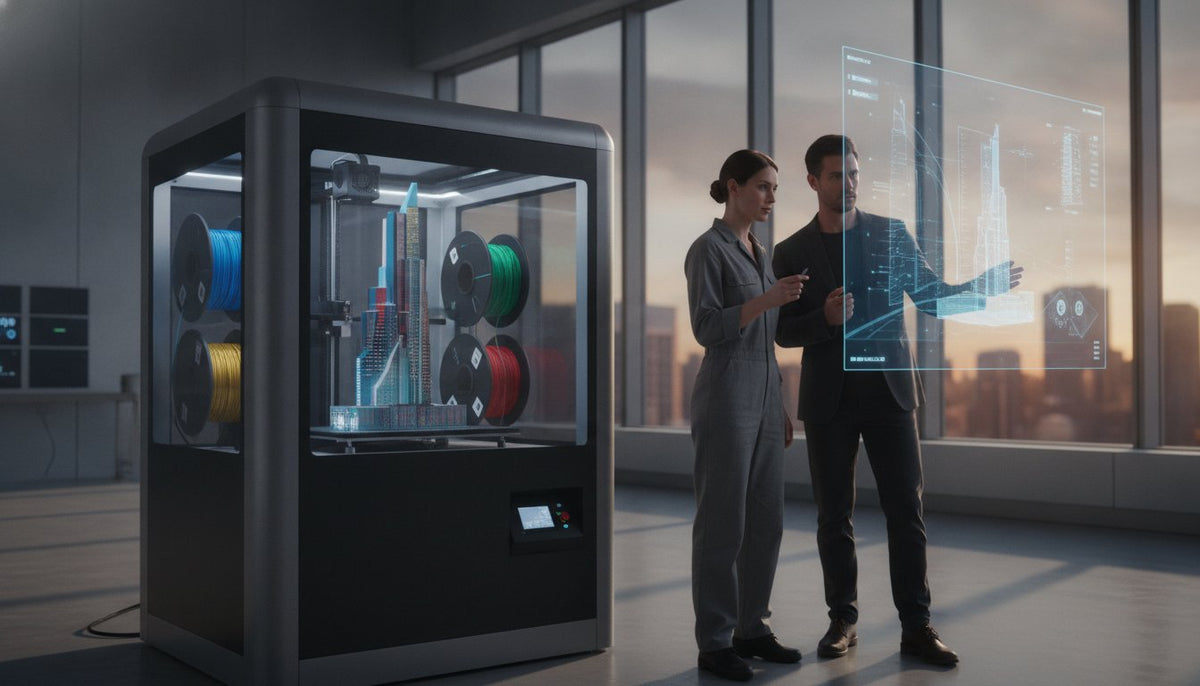
What if the most expensive 3D printer on the market is actually the wrong choice for your studio's specific workflow? It's a common dilemma for innovators across the United States who want to scale their production but feel stuck between choosing a hobbyist desktop unit or a full-scale industrial system. You've likely felt the frustration of comparing technical specs only to end up more confused about which bambu lab printers can truly handle engineering-grade filaments or provide the multi-color precision your clients demand.
We understand that investing in new hardware isn't just about the machine; it's about the reliability of the ecosystem and the local support behind it. This guide promises to clear the fog, helping you discover exactly which model matches your creative goals, from accessible entry-level units to high-performance manufacturing setups. We'll explore the critical differences between CoreXY and bed-slinger motion systems, the massive workflow advantages of the AMS multi-color system, and how to ensure your investment is backed by professional installation and training from Additronix. By the end of this article, you'll have a clear roadmap to optimize your studio's output with confidence.
Key Takeaways
- Compare CoreXY and bed-slinger motion systems to determine which architecture best supports your studio's required precision and production speed.
- Match your specific material needs to the right hardware, ensuring your bambu lab printers can reliably process everything from standard PLA to advanced engineering-grade filaments.
- Evaluate the distinct advantages of the A, P, X, and H series to bridge the gap between desktop prototyping and industrial-scale manufacturing.
- Streamline your setup process by understanding the value of local UAE support, including professional installation and specialized software training.
- Optimize your workflow efficiency by integrating the AMS multi-color system for automated material handling and complex multi-part builds.
The Bambu Lab Revolution: Why These Printers Lead the Market in 2026
Bambu Lab didn't just release new hardware; they redefined what users expect from a 3D printer. Before their arrival, the industry was defined by "tinkering," where enthusiasts spent more time leveling beds and tightening belts than actually creating. By 2026, bambu lab printers have solidified their position as the gold standard for out-of-the-box reliability. This shift towards a "click and print" experience allows UAE studios to focus on output rather than maintenance. It's no longer about whether the print will finish, but how fast you can iterate on your next design.
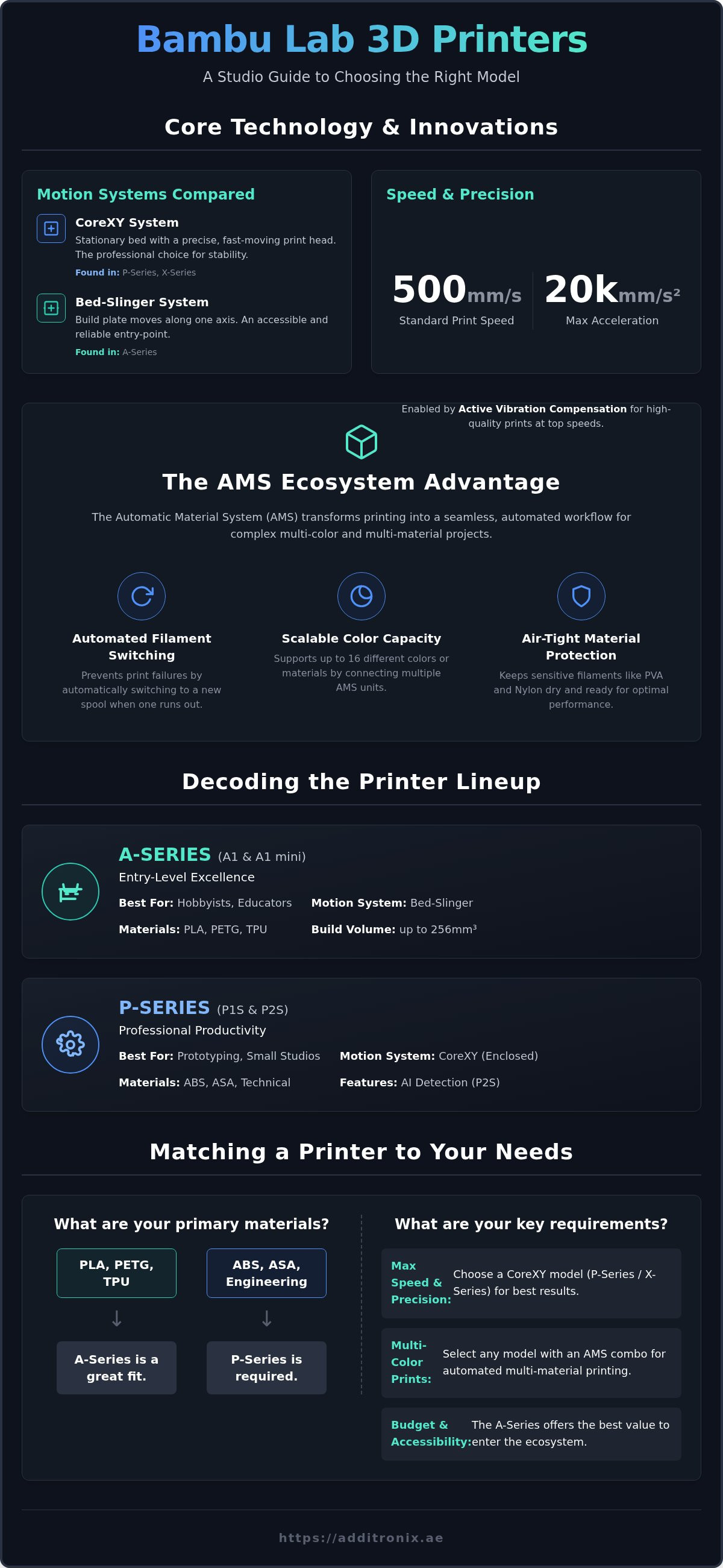
The choice between motion systems is a fundamental part of this success. CoreXY models, like the P-series and X-series, use a stationary bed and a synchronized belt system to move the print head with incredible precision. Bed-slingers, found in the A-series, move the build plate itself along the Y-axis. While bed-slingers offer an accessible entry point for educators, CoreXY remains the professional choice for those who need high-speed stability and enclosed environments for technical materials. Today, these systems have evolved into multi-tool hubs that integrate printing, light cutting, and engraving into a single workflow.
Speed and Acceleration: 500mm/s and Beyond
Speed is a metric that many brands claim, but few deliver with precision. These machines achieve a standard print speed of 500mm/s, but the real engineering feat lies in the 20,000 mm/s² acceleration. This power allows the print head to reach top speeds almost instantly, even on small, intricate parts. Active vibration compensation acts as the brain of the operation, sensing mechanical resonances and adjusting motor movements in real-time. This technology is why you can now print a high-quality "Benchy" model in under 15 minutes, a task that previously took nearly an hour on legacy hardware.
The Ecosystem: Bambu Studio and AMS
A printer is only as good as the software that drives it. Bambu Studio serves as the bridge between digital design and physical output. This ecosystem integrates seamlessly with the MakerWorld library, allowing users to send files directly to their machines with optimized settings. The Automatic Material System (AMS) takes this further by enabling multi-color and multi-material printing without manual intervention. It's a comprehensive solution that removes the traditional barriers to entry in professional manufacturing.
- Automated Handling: The AMS features automatic filament runoff switching to prevent failed prints when a spool ends.
- Scalable Color: Support for up to 16 colors when daisy-chaining multiple AMS units.
- Material Protection: Air-tight storage keeps sensitive filaments like PVA or Nylon dry and ready for use.
Decoding the Bambu Lab Lineup: A, P, X, and H Series
Selecting the right hardware requires a clear understanding of how each series performs under pressure. bambu lab printers are categorized into distinct tiers to serve varying levels of complexity and material requirements. Whether you're an educator looking for a reliable classroom tool or an engineer developing functional prototypes, there's a specific model designed to handle your workload.
Entry-Level Excellence: The A1 and A1 mini
The A1 mini and A1 represent the entry point into the ecosystem. These models utilize a "bed-slinger" design, where the build plate moves along the Y-axis. The A1 mini is the most compact option, offering a 180mm³ footprint that's perfect for desktop makers with limited space. Its larger sibling, the A1, provides a full 256mm³ build volume while maintaining a top speed of 500mm/s. Both machines are optimized for "open" materials like PLA, PETG, and TPU, providing a high-quality finish without the need for an enclosure.
Professional Productivity: P1S vs. P2S
If your projects require technical filaments like ABS or ASA, the P-series offers the stability of an enclosed CoreXY system. The P1S is a reliable workhorse for those who need high-temperature capabilities on a budget. In contrast, the P2S Combo introduces 2026 advancements such as a 5-inch touch screen and integrated AI failure detection. For studios running multi-color projects, the P1S AMS 2 Pro Combo offers enhanced material management compared to the standard P1S, ensuring smoother transitions between different spools. You can find the latest professional models in our local UAE stock to start upgrading your production capacity today.
The Flagship X1-Carbon and the Industrial H-Series
The X1-Carbon is the flagship choice for creators who demand the highest level of automation. It utilizes dual auto-bed leveling and AI-driven first layer inspection to eliminate the guesswork from the printing process. For enterprise-grade applications, the 2026 H-series acts as a "Swiss Army Knife" for personal manufacturing. The H2D Pro is specifically engineered for high-performance polymers, featuring a 350°C hotend and 65°C active chamber heating to prevent warping. The H2C AMS Combo complements this by offering purge-saving multi-material printing, making complex engineering parts more efficient than ever before.
Selection Criteria: Matching a Printer to Your Needs
Choosing from the diverse range of bambu lab printers requires a clear assessment of your project's final application. It's easy to get distracted by top-tier specs, but the most efficient tool is the one that aligns with your specific material and volume requirements. If you're producing aesthetic models, a standard setup suffices. However, functional parts for the aerospace or automotive sectors in the UAE demand specific hardware traits that ensure long-term durability and dimensional accuracy.
Material Compatibility and Hotend Temperatures
Your choice of filament dictates your hardware needs. The Bambu Lab X1-Carbon Combo and the H2D Pro are non-negotiable for abrasive materials like Nylon with Carbon Fiber (PA-CF). These technical filaments quickly erode standard brass nozzles, making the hardened steel components found in the P and X series essential. These models feature all-metal hotends designed for sustained high-temperature performance without the risk of heat creep. Active Chamber Heating is a controlled heating system within the printer's enclosure that maintains a consistent ambient temperature to prevent thermal shrinkage and warping in large-scale ABS or engineering-grade prints. Without this thermal management, large functional parts often fail due to internal stresses during the cooling process.
Enclosed vs. Open-Frame: When Does It Matter?
The physical design of the printer significantly impacts your success rate with specific materials. Open-frame models like the A1 or A1 mini are excellent for classrooms or safe hobby spaces where visibility and ease of access are priorities. They handle PLA and PETG beautifully in stable environments. For technical materials, an enclosure is vital. The P1S, X1-Carbon, and H-Series provide a protected build area that is crucial for maintaining print quality. In the UAE, enclosures protect your prints from airborne dust and the fluctuating temperatures of air-conditioned studios. This stability leads to higher success rates, better layer adhesion, and significant noise reduction during long production runs.
Build volume and multi-material capabilities also play a role in your final budget. Requirements range from the 180mm³ A1 mini to the expansive 350mm³ H2D series. While the standalone units are capable, most professionals find the "Full Combo" packages more cost-effective. The AMS system isn't just for aesthetic multi-color prints; it's a productivity tool that allows for automated support material integration and seamless filament backup when a spool runs dry. Evaluate whether your workflow benefits more from the speed of a single-tool setup or the versatility of a multi-material system before making your final selection.
Top Bambu Lab Recommendations for 2026
Success in 2026 depends on choosing hardware that grows with your ambitions. While the entire lineup shares a common DNA of speed and reliability, specific models excel in different professional environments. Finding the right balance between initial investment and long-term capability is key to maintaining a competitive edge in the UAE's fast-paced manufacturing market. These bambu lab printers represent the peak of current desktop and industrial technology.
- Best for Beginners: The Bambu Lab A1 mini Series offers an unbeatable entry point. It provides a plug-and-play experience with high-quality results, making it the ideal choice for educators and first-time makers who prioritize ease of use and price.
- Best for Small Businesses: The Bambu Lab P2S Combo is the 2026 standard for reliability. With integrated AI monitoring and a robust enclosure, it handles consistent production runs with minimal oversight.
- Best for Industrial Prototyping: The Bambu Lab H2D Pro is engineered for the toughest assignments. Its support for high-temperature materials ensures that functional prototypes meet the rigorous standards of engineering firms.
- The Ultimate Maker Tool: The Bambu Lab H2C Laser Full Combo (40W) is a 4-in-1 powerhouse. It bridges the gap between traditional 3D printing and advanced fabrication by incorporating printing, laser cutting, and engraving into a single, compact system.
The 'Smart' Choice: P1S AMS 2 Pro Combo
For most professional users, the P1S AMS 2 Pro Combo represents the "sweet spot" of the 2026 lineup. It balances the high-speed motion system of the CoreXY architecture with the expanded multi-color versatility of the AMS 2 Pro. When you analyze the total cost of ownership, this model often outperforms the X1-Carbon for studios that don't strictly require lidar-based first-layer inspection. It offers a professional-grade enclosed environment that's perfect for consistent results with common engineering filaments. To secure your setup, you can browse the complete range of Bambu Lab printers available for nationwide delivery.
Large-Format Specialist: Bambu Lab H2S AMS Combo
When scale is your primary requirement, the H2S AMS Combo delivers a massive 340×320×340mm build volume. This machine isn't just about size; it's built for extreme efficiency with a top speed of 1000mm/s. Ultra-high speed becomes a necessity when you're iterating on large architectural models or functional automotive parts that would otherwise take days to complete. The H2S ensures that even your largest projects maintain the precision and surface quality expected from the Bambu Lab ecosystem, allowing you to move from concept to physical reality faster than ever before.
Why Source Your Bambu Lab Printer from Additronix UAE?
Sourcing bambu lab printers within the UAE shouldn't be a logistical hurdle. While international retailers offer hardware, they often leave buyers to manage complex import duties and shipping delays that stall production. Additronix serves as your local partner, maintaining a robust inventory of machines like the X1-Carbon and the industrial H2D Pro right here in the region. This local presence ensures fast delivery and complete transparency, removing the uncertainty of hidden costs from your procurement process. We don't just sell boxes; we provide a complete gateway to local manufacturing success.
Professional Training and Installation Services
Buying advanced hardware is only the first step. Mastering it requires a structured approach. An Additronix professional setup session includes more than just unboxing; our team handles the physical installation and provides comprehensive software training. We help your staff master Bambu Studio and the complexities of multi-material printing with expert guidance. This service significantly reduces the learning curve for corporate teams and educational institutions, ensuring you're productive from the moment the machine arrives. We bridge the gap between technical hardware and professional output through hands-on education.
Local Support and the UAE 'Heat Factor'
The Middle Eastern climate presents unique challenges for precision hardware and materials. High ambient temperatures and humidity levels can degrade filament quality or affect printer calibration if not managed correctly. We provide expert advice on climate-controlled filament storage and maintenance routines specifically tailored to local conditions. Our Dubai and Abu Dhabi hubs offer immediate access to AMS spare parts and replacement nozzles, ensuring your workflow remains uninterrupted. You won't have to wait weeks for international shipping when a critical component needs replacement.
Our curated ecosystem further enhances your results by matching your hardware with premium materials like Polymaker PolyLite PLA. This synergy between high-performance machines and reliable consumables ensures consistent, professional-grade prints every time. By choosing an authorized local supplier, you secure a long-term partnership that includes full warranty support and professional technical assistance. Explore the full Bambu Lab collection at Additronix and start your journey today!
Future-Proof Your Production with Precision Engineering
The transition from concept to high-performance reality is no longer a complex engineering hurdle. By selecting the right hardware from the 2026 lineup, you've already taken the first step toward optimizing your studio's creative output. Remember that the most effective bambu lab printers aren't just about raw speed; they're about the synergy between motion systems, material compatibility, and the intelligent AMS ecosystem. Whether you're deploying an A1 mini for desktop prototyping or an industrial H2D Pro for functional parts, your choice defines the scale of your success.
Partnering with an authorized supplier ensures your investment is protected by expert knowledge and local reliability. Additronix provides the all-in-one support you need to stay productive, offering fast nationwide UAE delivery alongside professional on-site installation and training. This comprehensive approach eliminates the learning curve and keeps your workflow moving forward. Shop the Complete Bambu Lab Collection at Additronix UAE and secure the tools that will drive your innovation for years to come. Your next breakthrough is ready to be printed.
Frequently Asked Questions
Which Bambu Lab printer is best for beginners in 2026?
The Bambu Lab A1 mini is the superior choice for beginners in 2026. It features a simplified auto-calibration system that handles everything from bed leveling to vibration compensation without user input. Its compact 180mm³ build volume is ideal for desktop spaces. While it's affordable, it doesn't sacrifice speed, reaching the same 500mm/s velocity as the professional models. This makes it a perfect entry point for students and hobbyists.
Is the AMS system compatible with all Bambu Lab printers?
Compatibility depends on the specific hardware generation. The standard AMS is designed for the enclosed X and P series models, while the AMS Lite is built exclusively for the A series bed-slingers. These two systems aren't interchangeable due to different feeding mechanisms. If you're using bambu lab printers for multi-material projects, ensure you select the correct version to avoid hardware conflicts and ensure seamless filament transitions.
What is the difference between the P1S and the new P2S Combo?
The primary difference lies in the user interface and safety automation. The P1S utilizes a basic screen and relies on manual monitoring. In contrast, the P2S Combo introduces a vibrant 5-inch touch screen and integrated AI failure detection. This system automatically pauses the print if it detects "spaghetti" or first-layer issues. This upgrade makes the P2S a more reliable workhorse for small businesses that need to run machines unattended.
Can the H2D series really replace a laser engraver and plotter?
The H2D series is engineered as a true 4-in-1 manufacturing system. It effectively bridges the gap between 3D printing and secondary fabrication processes. The H2C Laser Full Combo includes a powerful 40W laser module capable of cutting through wood and acrylic, alongside a plotter tool for precision drawing. While it won't replace a large-scale industrial CNC, it provides an all-in-one solution for studios that need versatile prototyping in a single footprint.
Do I need special training to operate a Bambu Lab X1-Carbon?
While the X1-Carbon is famous for its ease of use, professional training is highly beneficial for corporate environments. Additronix provides specialized sessions that cover advanced slicing techniques in Bambu Studio and maintenance for technical filaments. This training ensures your team avoids common pitfalls like nozzle clogs or bed adhesion issues. It's about maximizing your return on investment and ensuring your studio stays productive from the very first day of installation.
Why should I buy from a UAE distributor like Additronix instead of ordering globally?
Buying from a local UAE distributor like Additronix eliminates the risk of import surprises and shipping damage. You receive immediate access to local stock and a valid UAE warranty that international sellers cannot provide. We also offer on-site support and training which is impossible with global orders. This ensures that if you need a spare part for your bambu lab printers in Dubai or Abu Dhabi, you can get it the same day.
Which Bambu Lab model is best for printing carbon fiber filaments?
The Bambu Lab X1-Carbon and the H2D Pro are the top contenders for printing abrasive materials like carbon fiber. These models come standard with hardened steel nozzles and gear systems that resist the wear caused by fiber particles. Their enclosed chambers also maintain the high ambient temperatures necessary to prevent warping in engineering-grade filaments. Using an A-series for these materials will quickly degrade the nozzle and lead to inconsistent extrusion.
What are the power requirements for the H2C Laser Full Combo in the UAE?
The H2C Laser Full Combo is designed to run on the standard UAE 220-240V electrical grid. However, because it integrates a 3D printer, a 40W laser, and active chamber heating, it has a higher peak power draw than standard desktop units. It's best to connect this machine to a dedicated circuit to ensure stability during long production runs. Our installation team can verify your studio's power setup during the initial professional configuration process.