
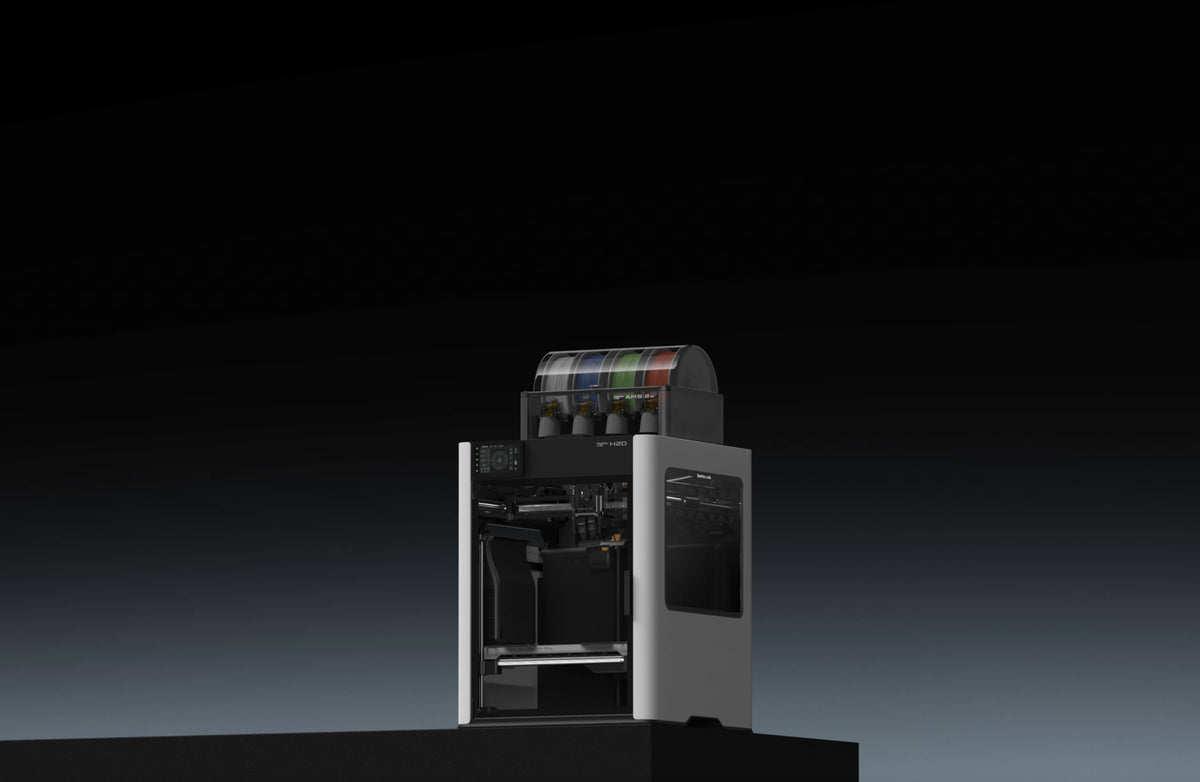
The H2D vs H2S debate is one of the most common questions among serious makers in the UAE right now, and it makes sense why. Both machines sit at the top of Bambu Lab's H-series lineup, both are built for enclosed, high-performance printing, and both carry a price tag that deserves real thought before you commit. Whether you are upgrading from a P1S or stepping into a professional-grade setup for the first time, the differences between these two will shape how you work for years.
Here is a clear, side-by-side breakdown to help you decide.
What the H-Series Is Built For
Bambu Lab's H-series represents the brand's most capable enclosed FDM systems. The A-series and P-series target hobbyists and prosumers who want speed and multi-material convenience. The H-series is for users who need consistent results with engineering-grade materials, tighter tolerances, and longer unattended print runs.
Both the H2D and H2S share that core philosophy. Fully enclosed, temperature-controlled chambers let you run materials like PA-CF, PPS-CF, and PETG-CF without worrying about warping or delamination. Both support Bambu Lab's AMS ecosystem for multi-material printing. Both are significantly larger and more capable than anything in the P-series.
The question is not which one is good. It is which one fits your actual workflow.
Build Volume and Physical Footprint
The H2D ships with a notably larger build volume than the H2S. If you regularly print large functional parts, enclosures, or anything that pushes the limits of a standard build plate, that extra room matters.
The H2S is still a large machine by any reasonable measure, and its build volume suits most professional and studio workflows. But if you have ever had to split a print into two pieces because the bed was not quite big enough, the H2D's additional space will make a real difference.
Both machines are physically substantial. Before ordering either, measure your workspace. The H-series is not a casual desktop printer — these are workstation-class machines that need proper placement, ventilation, and a dedicated surface.
Chamber Temperature and Material Compatibility
This is where the two machines diverge most meaningfully. The H2D is engineered to maintain a higher sustained chamber temperature than the H2S, which matters specifically when you are printing high-performance engineering materials that require an actively heated enclosure to prevent layer adhesion failures.
Materials like PPS-CF, PA612-CF, and certain high-temperature PA variants need a chamber that can hold consistent heat throughout a long print. The H2D is built for those conditions. The H2S handles a strong range of engineering filaments — including PA-CF and PETG-CF — but its thermal ceiling is lower.
If your workflow involves:
- PA-CF or PETG-CF for functional mechanical parts
- ASA or ABS for outdoor or heat-resistant applications
- TPU for flexible components
The H2S handles all of those reliably. If you are moving into PPS-CF, high-temperature polyamides, or materials that demand sustained elevated chamber temperatures, the H2D is the machine you need.
Additronix stocks engineering-grade filaments including Fiberon PPS-CF10, Fiberon PA612-CF15, eSun PA-CF, eSun PETG-CF, and Bambu Lab PA6-CF. If you are buying the printer specifically to work with those materials, it is worth confirming which machine your target filament actually requires before placing your order. The team at Additronix is available via WhatsApp if you want to talk through material compatibility before committing.
The Laser Module: H2D's Defining Feature
The H2D is not just a 3D printer. It is a hybrid manufacturing platform. Bambu Lab offers it in configurations that include an integrated laser module — the H2D Laser Full Combo 40W being the flagship version. That 40W laser turns the machine into a laser engraver and cutter without requiring a separate device.
For a small studio or product design operation, this is a significant capability. You can print a part, engrave branding, cut gaskets from sheet material, or prototype packaging — all within the same machine footprint.
The H2S does not include a laser module. It is a pure FDM printer.
If laser cutting or engraving is part of your workflow, or if you want the option to add it later, the H2D is the only choice between these two. If you have no use for laser functionality and are focused purely on FDM output, paying for the laser combo configuration is not necessary.
Multi-Material Printing and AMS Support
Both machines support Bambu Lab's AMS for multi-material and multi-color printing. The H2D AMS Combo and H2D Laser Full Combo 40W include AMS units, and the H2S is similarly available in AMS combo configurations.
The AMS 2 Pro — which Additronix stocks as a standalone accessory — is compatible with the H-series and lets you run up to four materials simultaneously. Whether you are printing multi-color functional parts or combining a support material like PVA with your primary filament, the AMS integration on both machines handles that workflow well.
There is no meaningful difference in multi-material capability between the H2D and H2S at the AMS level. Both use the same ecosystem.
Print Speed and Motion System
Both machines use Bambu Lab's CoreXY motion system, which underpins the brand's reputation for fast, accurate printing. The H-series builds on the same motion architecture as the P-series but adds the thermal and structural features needed for engineering materials.
In practice, both machines are fast. The difference in print speed between the H2D and H2S is not what drives most buying decisions. The choice usually comes down to chamber temperature, build volume, and the laser module — not raw speed.
H2D vs H2S: Which One Should You Buy?
Here is a straightforward way to think about it.
Choose the H2D if:
- You need a larger build volume for bigger parts
- You want to print high-temperature engineering materials like PPS-CF or PA612-CF that require sustained elevated chamber temperatures
- You want integrated laser engraving and cutting capability now or in the future
- You are running a small studio or product design operation where the hybrid functionality justifies the investment
Choose the H2S if:
- Your material needs are covered by PA-CF, PETG-CF, ASA, ABS, and similar mid-range engineering filaments
- You do not need laser functionality
- You want a top-tier enclosed FDM printer without paying for features you will not use
- You are upgrading from a P1S or P1S Combo and want a meaningful step up in capability
The H2S is not a compromise. It is a serious machine that outperforms most of what is available in its class. The H2D is for buyers who specifically need what it adds: more volume, higher chamber temperatures, or the laser module.
Buying the H2D or H2S in the UAE
Once you have chosen your model, the practical question is where to buy it. Ordering from overseas means customs clearance, potential import friction, and no local support if something needs attention after delivery.
Additronix stocks the Bambu Lab H2D, H2D AMS Combo, and H2D Laser Full Combo 40W locally in the UAE, with free delivery on orders above AED 650. Prices are listed in AED on individual product pages at additronix.ae. To confirm stock availability or talk through which H-series configuration suits your setup, the WhatsApp support line is the fastest way to get a direct answer before you place your order.
FAQs
What is the main difference between the Bambu Lab H2D and H2S? The H2D offers a larger build volume, a higher sustained chamber temperature for demanding engineering materials, and an optional integrated laser module. The H2S is a high-performance enclosed FDM printer without the laser capability and with a lower thermal ceiling — a better fit for users who do not need those specific features.
Can the H2S print PA-CF and PETG-CF filaments? Yes. The H2S handles PA-CF, PETG-CF, ASA, ABS, and similar engineering-grade filaments well. If you need to print higher-temperature materials like PPS-CF or PA612-CF that require a sustained elevated chamber, the H2D is the more appropriate machine.
Does the Bambu Lab H2D come with a laser module included? Not in every configuration. The H2D is available as a base model, as an AMS Combo, and as the Laser Full Combo 40W, which includes the 40W laser module. You need to select the Laser Full Combo specifically to get the laser functionality.
Is the AMS system compatible with both the H2D and H2S? Yes. Both machines support Bambu Lab's AMS ecosystem for multi-material and multi-color printing. The AMS 2 Pro is available as a standalone accessory and is compatible with the H-series.
Where can I buy the Bambu Lab H2D or H2S in the UAE? Additronix stocks both H-series models locally at additronix.ae, with pricing in AED and free delivery across the UAE on orders above AED 650. WhatsApp support is available to confirm stock and configuration options before you order.
Which H-series model is better for a small product design studio? The H2D is generally the better fit for a studio workflow, particularly if you want the laser module for engraving or cutting alongside FDM printing, or if you regularly work with high-temperature engineering materials. The H2S is a strong choice for studios focused purely on FDM output with PA-CF and similar materials.
Do I need to use high-temperature filaments just because the H2D supports them? No. The H2D runs standard materials like PLA, PETG, and ASA just as well. The higher chamber temperature is there when the material demands it — not a requirement for every print.
The Right Machine Is the One That Matches Your Work
The H2D vs H2S decision comes down to what you are printing and whether the H2D's additional capabilities justify its higher price for your specific use case. Both machines are serious tools built for users who have moved past entry-level printing and want consistent, professional results.
If you are ready to choose, additronix.ae stocks both H-series configurations with UAE-local fulfillment, AED pricing, and WhatsApp support to help you get the right setup from the start.