
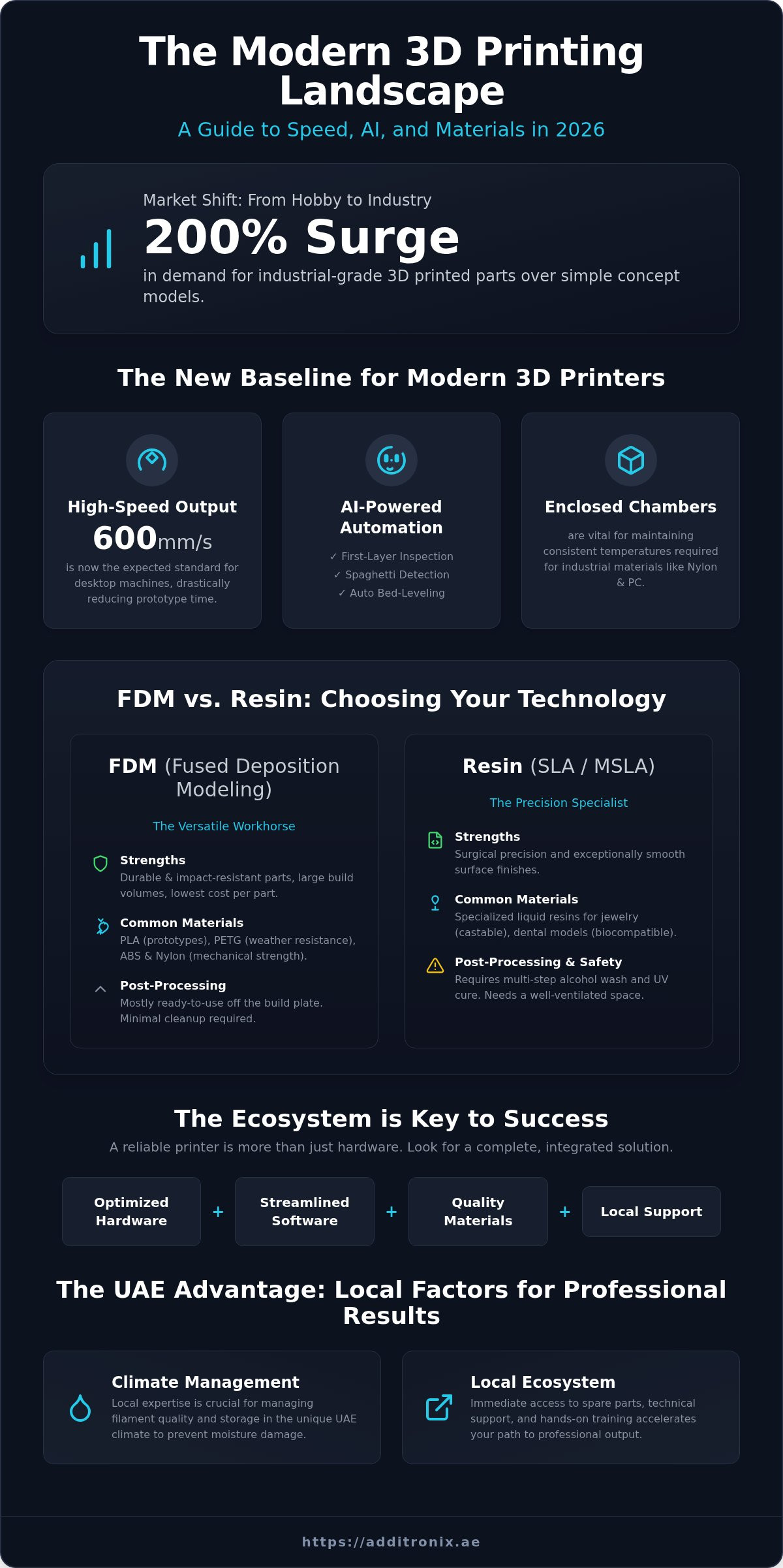
Did you know that requests for industrial-grade 3D printed parts have surged by 200% over simple concept models across various sectors? This shift proves that 3D printers are no longer just tools for hobbyists; they're the backbone of a new era in modern manufacturing. You likely want a machine that delivers professional results without the frustration of constant troubleshooting or the worry of finding readily available and compatible filaments. It's a common challenge to choose between FDM and Resin technology while ensuring you have access to the necessary training and parts required for success.
At Additronix, we've designed this guide to help you identify the perfect machine for your hobby, profession, or industrial enterprise. You'll discover how to achieve a reliable plug-and-play experience by leveraging the latest AI-driven automation and high-speed hardware. We'll examine the technical differences between top-tier models and show you how to build a complete ecosystem that guarantees long-term output quality. From understanding industry best practices to selecting the right materials, this is your roadmap to mastering the technology in 2026.
Key Takeaways
- Understand why high speed output and AI failure detection are now the baseline performance standards for modern 3d printers.
- Learn how to select between FDM and Resin technologies by matching your specific project requirements to the right material properties and detail levels.
- Identify the essential hardware specifications, including high temperature nozzles and heated chambers, necessary for working with industrial grade materials.
- Discover how to manage the unique UAE climate factors that impact filament quality and why local training accelerates your path to professional results.
- Explore the benefits of a complete local ecosystem that provides immediate access to spare parts and technical support to keep your production moving.
The 3D Printing Landscape in 2026: Speed, AI, and Ecosystems
By 2026, the perception of additive manufacturing has fundamentally shifted. It's no longer a niche hobby for weekend enthusiasts; it's a robust production tool used by engineers and manufacturers across the UAE. If you want to understand what 3D printing is in a modern context, look at the factory floor rather than the garage. Today's 3d printers are precision instruments designed for high-volume output and extreme reliability. High-speed printing, once a premium upgrade, is now a baseline expectation. Most desktop units now reach speeds of up to 600 mm/s, allowing you to move from digital design to physical prototype in a fraction of the time required just a few years ago.
Artificial Intelligence has removed the guesswork from the manufacturing process. Modern machines utilize AI-powered cameras for first-layer inspection and spaghetti detection to pause prints the moment a failure occurs. These AI features act as a digital supervisor, protecting your investment and reducing material waste. This automation, combined with a shift toward fully enclosed systems, ensures better material versatility. Enclosures maintain consistent internal temperatures, which is vital for successfully printing technical materials like Nylon or Polycarbonate without the risk of warping or structural weakness.
The Death of the "Tinkerer" Machine
The era of the tinkerer machine is over. In the past, users spent more time calibrating their equipment than actually printing, often resulting in frustration and wasted material. Modern units like the Bambu Lab A1 have replaced manual bed leveling with sophisticated auto-calibration sensors. You don't need to be a mechanical engineer to get professional results anymore. Powerful slicer software like Bambu Studio or Creality Print streamlines the entire workflow. These programs handle the complex geometry calculations automatically, making the transition from a 3D model to a physical object nearly instantaneous for the user.
Why Ecosystem Matters More Than Specs
In the current market, hardware specifications are only one part of the equation. A true 3D printing ecosystem integrates hardware, software, materials, and local support into a single, seamless experience. Proprietary systems offer significantly higher success rates for beginners because every component is optimized to work together. You're buying a solution, not just a box of parts. Local support is the final pillar of this success. Having access to in-country stock for parts and filaments ensures your projects never hit a standstill. In 2026, the best 3D printer is not the one with the highest specs, but the one with the most reliable ecosystem.
FDM vs. Resin: Which Technology Suits Your Output?
Choosing between FDM and Resin technology is the first major decision you'll make. It defines your entire workflow, from the materials you buy to the amount of space you need in your workshop. FDM (Fused Deposition Modeling) uses spools of plastic filament to build parts layer by layer. It's the most common choice for functional items because the resulting parts are durable and impact-resistant. Resin printing, often called SLA or MSLA, uses a liquid photopolymer cured by light. This method is the undisputed leader for projects that require surgical precision and smooth surface finishes.
Material choice also separates these two technologies. FDM 3d printers typically run on PLA for easy prototypes, PETG for weather resistance, or ABS for mechanical strength. Resin printers utilize specialized liquids designed for specific industries, such as castable resins for jewelry or biocompatible options for dental models. While FDM parts are mostly ready to use the moment the print finishes, resin prints require a multi-step post-processing routine involving an isopropyl alcohol wash and a final UV cure. Safety is another factor; resin requires a dedicated, well-ventilated space due to odors and chemical handling, whereas FDM PLA is generally low-odor and beginner-friendly.
FDM Printers: The Versatile Workhorses
If you need to produce functional prototypes, household tools, or large-scale mechanical parts, FDM is your best option. These machines handle large volumes efficiently and offer the lowest cost per part. The Creality K1 Max 3D Printer is a standout choice for those needing a large build area and high-speed production. For users who want to experiment with aesthetics, the Bambu Lab X1-Carbon Combo offers an integrated multi-color filament system. This allows you to create complex, multi-material parts without the need for manual painting or assembly. Explore our curated selection of professional-grade 3d printers to find the tech that fits your workflow.
Resin Printers: The Precision Specialists
Resin machines are the go-to choice for miniatures, intricate jewelry, and high-detail figurines. The Elegoo Saturn 3 Ultra represents the peak of desktop precision, offering the high resolution necessary to eliminate visible layer lines. In the world of resin, resolution refers to the pixel density of the LCD screen used to cure the layers. A higher resolution means the machine can reproduce microscopic details that FDM simply cannot match. You'll achieve a surface finish that feels like injection-molded plastic, which is essential for professional-grade display models or master molds.
Top 3D Printer Picks for Every User Level
Selecting the right machine requires balancing your specific output goals with your technical experience. In 2026, the price of 3d printers reflects their level of automation, speed, and thermal stability rather than just the physical size of the build plate. While an entry-level machine might offer the same build volume as a professional unit, the professional model provides the consistency needed for repeat production. Our "Best Value" pick for this year remains the Bambu Lab P2S Combo, as it balances high-speed CoreXY performance with a fully enclosed environment at a mid-range investment level. You can explore these options and more in the Additronix 3D Printer Collection.
Best for Beginners and Educators
If you're looking for a plug-and-play experience that removes the steep learning curve, start here. The Creality SPARKX i7 stands out for its smart AI integration, allowing for automated desktop printing with multi-color support. It's a reliable choice for classrooms where ease of use is paramount. Similarly, the Bambu Lab A1 Series has become the gold standard for bed-slingers that "just work." These machines handle auto-calibration and material loading with minimal user intervention, making them perfect for those who want to focus on design rather than hardware maintenance.
Best for Prosumers and Small Businesses
Small businesses and serious makers need machines that handle engineering-grade materials and run for long hours. The Bambu Lab P2S Combo features an enclosed CoreXY design and AI failure detection, ensuring high success rates for complex prints. For those who need extreme material versatility, the Elegoo Centauri Carbon 2 Combo offers a high-temperature nozzle capable of reaching 350°C. If your workflow requires professional dual-nozzle printing, the Bambu Lab X2D Combo includes active chamber heating, which is essential for preventing structural defects in technical plastics.
Best for Enterprise and Industrial Prototyping
Enterprise users require maximum precision and multi-functional capabilities. The Bambu Lab H2D Pro provides an industrial-grade ecosystem with 350°C hotends and actively heated chambers to ensure part accuracy across large batches. When massive scale is the priority, the Creality K2 Plus Combo offers a 350mm³ build volume for manufacturing large components in a single piece. For the ultimate all-in-one solution, the Bambu Lab H2C Laser Full Combo allows you to 3D print, laser engrave, cut, and plot within a single workspace, maximizing your facility's productivity. These high-performance 3d printers are designed to bridge the gap between prototyping and end-use manufacturing.
Essential Features to Compare Before You Buy
Buying the largest machine available is a common mistake for many new users. While a massive build volume looks impressive on a spec sheet, you must consider the desktop footprint and heating efficiency. Large build plates require significantly more power and time to reach operating temperatures. If your primary output consists of small mechanical components or brackets, a compact machine with a faster heating cycle will increase your daily productivity. Precision and thermal management often outweigh raw size in a professional workflow.
Temperature capabilities define which materials you can actually use. Standard 3d printers often peak at 260°C, which limits you to basic plastics like PLA or PETG. If you intend to manufacture functional parts, look for a machine that reaches 300°C or higher. This heat level is necessary for technical materials like Nylon and Polycarbonate. You also need to verify if the machine features an actively heated chamber. Without a controlled internal environment, high-performance filaments will warp and lose structural integrity as they cool too quickly.
The motion system of your printer dictates its maximum reliable speed. Traditional "bed-slinger" designs move the heavy build plate back and forth, which can cause "ghosting" or ringing artifacts at high speeds. CoreXY systems keep the bed stationary or move it only vertically, allowing the lightweight print head to move with extreme agility. This design is the superior choice for maintaining accuracy at speeds above 300 mm/s. Compare the latest 3d printers to see how these motion systems impact your specific production goals.
The Power of Multi-Material Printing
Automated material handling systems have revolutionized the design process. Units like the Bambu Lab AMS or Creality CFS allow you to load multiple spools simultaneously. This technology enables automated color changes and the use of soluble support materials. You don't have to perform manual filament swaps mid-print anymore. This shift saves hours of labor and allows for the creation of complex geometries that were previously impossible to print. Advanced machines like the H2C series even include purge-saving technologies to minimize material waste during these transitions.
AI and Automation: Your Insurance Policy
Modern automation acts as a digital insurance policy for your projects. Systems equipped with LIDAR and high-resolution cameras perform a "First Layer Inspection" before the main print begins. This detects 90% of potential failures before they waste your time and material. Features like the Active Flow Dynamics Calibration found in the Bambu Lab P2S ensure that the plastic extrudes perfectly regardless of minor filament variations. In 2026, AI detection is the difference between a successful overnight print and a wasted spool of filament.
The UAE Advantage: Why Local Support Matters
Operating 3d printers in the UAE presents a unique set of challenges that international guides often overlook. The primary obstacle is the "UAE Heat Factor." High ambient humidity can compromise the integrity of filaments like PLA and TPU within a few hours of exposure, leading to brittle prints and surface defects. Beyond environment, logistics play a massive role in your success. In a fast-paced market like Dubai or Abu Dhabi, waiting four weeks for a critical spare part from an overseas retailer can halt your entire production line. Local availability is not just a convenience; it's a requirement for maintaining professional productivity.
Choosing a partner that supports the full lifecycle of your equipment is the final step in your buying journey. You need more than just a box delivered to your door; you need a reliable ecosystem that includes technical expertise and immediate access to consumables. By prioritizing local support, you ensure that your investment continues to deliver high-quality output without the risk of extended downtime. Whether you're a hobbyist or an industrial enterprise, the value of in-country stock and professional services cannot be overstated.
Managing Your Print Environment in Dubai
Success in a high-humidity climate requires a proactive approach to material management. You should utilize active dry boxes and sealed venting systems to protect your investment from moisture absorption. Enclosed printers, such as the Bambu Lab X1-Carbon Combo or the Bambu Lab P2S, offer a significant advantage by creating a stable micro-climate that's less affected by external air-conditioning cycles. Additronix supports this ecosystem with a vast inventory of Polymaker PolyLite PLA and other premium materials available for rapid local delivery. Keeping your filament dry ensures that the physical output matches your digital design every time.
Additronix: More Than Just a 3D Printer Shop
Owning high-end hardware is only half the battle. For complex industrial units like the H2D series, professional installation and training services are the keys to unlocking their full potential. You shouldn't have to spend weeks troubleshooting a machine that costs AED 10,000 or more. Expert-led training sessions provide your team with the specific knowledge needed to master advanced slicer settings and hardware maintenance. This comprehensive support structure ensures you move from unboxing to production without the typical learning curve frustrations. Explore the full 2026 3D Printer Collection at Additronix to find a partner committed to your long-term success.
Empower Your Production with 2026 Technology
The transition from digital concept to physical reality is faster and more reliable than ever. By prioritizing machines with AI-driven failure detection and high-speed motion systems, you ensure your creative workflow remains uninterrupted. Whether you select the surgical precision of resin or the mechanical durability of FDM, your success in 2026 depends on an ecosystem that supports your long-term growth and technical mastery.
As an authorized distributor for Bambu Lab and Creality, Additronix provides the specialized hardware and local expertise required to excel in the competitive UAE market. We don't just supply 3d printers; we offer a complete partnership through professional installation, expert-led training sessions, and nationwide delivery and support. This comprehensive approach ensures your equipment stays operational while your output remains professional-grade at every scale.
Take the next step in your creative or industrial journey today. It's time to move beyond simple prototyping and embrace the power of end-use manufacturing. Browse the UAE’s Largest Collection of 3D Printers and discover the technology that will redefine your production capabilities. Your vision is ready to take shape.
Frequently Asked Questions
What is the best 3D printer for beginners in the UAE?
The Bambu Lab A1 series is the top choice for beginners because it offers a true plug-and-play experience with full auto-calibration. It removes the frustration of manual bed leveling, allowing you to start printing professional-quality models within minutes of unboxing. Choosing a brand with local UAE support ensures you have a reliable partner for spare parts and technical guidance as you learn.
Can I use a 3D printer for small-scale manufacturing?
You can certainly use modern 3d printers for small-scale manufacturing, particularly machines with high-speed CoreXY motion systems. Units like the Creality K1 Max 3D Printer are built for continuous operation and can produce functional, end-use parts with high repeatability. This technology allows businesses to bypass expensive tooling costs and produce items locally on demand.
What is the difference between FDM and Resin 3D printers?
The primary difference is the material and the level of detail; FDM uses plastic filament for durable, functional parts, while Resin printers use liquid photopolymer for extreme precision. FDM is the versatile workhorse for mechanical components and large prototypes. Resin is the specialist tool for applications requiring smooth surface finishes, such as jewelry, dental models, and miniatures.
Do I need professional training to use an industrial 3D printer?
Professional training is highly recommended for industrial-grade units to ensure your team can master complex slicer software and material requirements. While basic machines are intuitive, industrial systems involve advanced thermal management and specific maintenance routines. Expert-led training sessions accelerate your learning curve and prevent operational errors that could lead to downtime.
How much should I spend on my first 3D printer in 2026?
Your investment should be dictated by the features required for your specific output goals rather than just the build size. In 2026, the value is found in automation features like AI failure detection and high-speed capabilities that ensure a higher success rate. It's better to invest in a reliable ecosystem that includes local support to avoid the hidden costs of troubleshooting and part replacement.
Are 3D printers compatible with all types of filament?
No, 3d printers are limited by their hardware specifications, particularly the maximum nozzle temperature and the presence of a heated chamber. Printing technical materials like Nylon or Polycarbonate requires a nozzle that can reach 300°C and a controlled internal environment to prevent warping. Always verify that your machine can handle the specific thermal requirements of filaments like Polymaker PolyLite PLA before starting a project.
How do I maintain my 3D printer in the UAE climate?
Maintaining a printer in the UAE requires a focus on humidity management and regular hardware cleaning. You must store your filaments in active dry boxes to prevent moisture absorption, which is a leading cause of print defects in high-humidity environments. Additionally, keep the motion system free of dust and ensure the cooling fans are clear to manage the internal temperatures effectively during long print cycles.
What is a multi-material system (AMS/CFS) and do I need one?
A multi-material system, such as the Bambu Lab AMS or Creality CFS, is an automated tool that swaps different filaments during a single print. You need one if your designs require multiple colors or specialized soluble support materials for complex geometries. These systems eliminate the need for manual filament changes, allowing the machine to handle intricate, multi-material projects completely unattended.